Bets
LPGA Preview & Picks: AIG Women’s Open


Ten years after earning her first LPGA victory at the 2016 Volunteers of America Texas Shootout, Jenny Shin took home her second trophy.
It was an impressive win in Scotland, where just 10 players finished under par and many of the game’s biggest stars were swept away along the western coast.
With three outrights finishing inside the top 19, we remain close and continue to contend week after week on both tours.
Shin has built a decent record across the pond, but at +15000—and even longer in some places—to begin the week, congratulations to her on earning a second career win a decade after the first.
Much like the men three weeks ago, the women will travel from the shores of Scotland to the western coast of England for the AIG Women’s Open.
Less than 10 miles north of Royal Birkdale, the conclusion of the women’s major championship season has a slight feeling of redundancy. Two famous English shoreline links layouts will conclude the men’s and women’s major seasons.
The entire top 10 of the Rolex Women’s World Golf Rankings is in the field.
Much like the men, the women have been here before—five times, in fact, with all five visits coming within the last 30 years.
The history of The Open Championship stretches back more than a century. The Women’s Open is celebrating its 50th edition.
Returning to these historic links in Lancashire sets the tone for what should be a fitting conclusion to the 2026 major championship season.
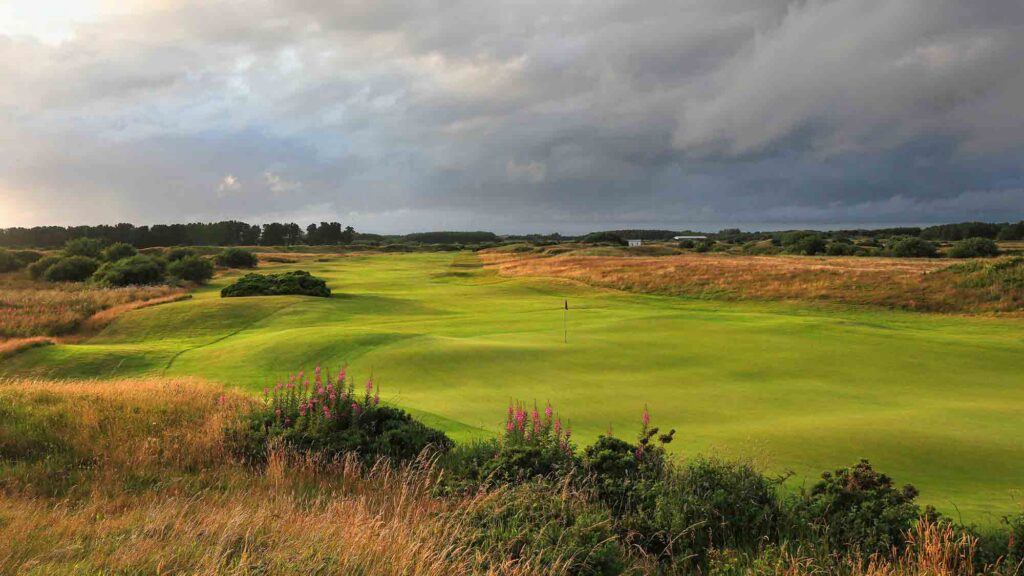
Every eight to 10 years or so, we return to Royal Lytham & St Annes and immediately remember one thing: this is the course that begins with a par 3.
Yes, the par-71 scorecard begins with a 180-yard par 3.
The course will measure 6,601 yards for the championship, with an additional par 4 and one fewer par 5 than a standard par-72 layout.
What I love most about links golf is the architects’ ability to use what the land gave them.
There are so many American courses on the PGA TOUR that feel as though the plans were drawn before anyone saw the setting.
Two weeks ago at Royal Birkdale, the men did not play a par 5 until the 14th hole. At Royal Lytham & St Annes, the par 5s are finished by the 11th.
A masterpiece of eclectic par 4s, the course closes with six in a row. Each is different from the next, and you can bet we will be closely tracking par-4 scoring.
Similar to the par 5s, the women will face all three front-nine par 3s before making the turn.
The warm weather at Royal Birkdale was not your typical English summer.
This week’s forecast calls for temperatures in the high 60s, with a slight chance of rain during the early-morning hours each day. That should be enough to keep the surfaces soft enough to receive a few well-struck approaches.
The wind is another story.
Royal Lytham & St Annes is not nearly as exposed as some links venues, but we are still expecting serious wind during the afternoons.
Each day should begin with a steady breeze in the low to mid-teens. By the afternoon, a steady wind coming off the Irish Sea from the west could produce gusts exceeding 25 mph.
The front nine takes players away from the clubhouse. The ninth green and 10th tee are the furthest points from the locker rooms.
A majority of the opening holes travel east. After making the turn, players will head west on six of the closing nine holes.
Keep the wind direction in mind. Players should be able to score on the front nine.
The only par 4 that travels west during the opening stretch is also the shortest. There are two par 5s on the front nine, and both should play downwind.
Avoid the 97 fairway bunkers, and players will be in position to attack early.
Yes, there are 97 fairway bunkers—and 168 bunkers in total.
Off the tee and on approach, this will be an accuracy contest.
We will take a deeper look at the historic men’s and women’s leaderboards in the outright section, but the variety of shots required here immediately stands out.
Much of that variety comes from the conditions.
Women have won the AIG Women’s Open at Royal Lytham at both 17-under and four-over par. That is quite a scoring differential for a course that has not fundamentally changed since hosting its first Open Championship in 1926.
Royal Lytham & St Annes has hosted five AIG Women’s Opens and 11 men’s Open Championships.
Take a look at this Hall of Fame list of past champions:
One interesting footnote: Since World War II, Royal Lytham & St Annes is the only Open venue to produce two English winners.
Uniquely, they are one man and one woman—Tony Jacklin and Georgia Hall.
Hall’s closing 67 on Sunday was impressive in 2018. She made six birdies through the first 16 holes, hit 15 of 18 greens in regulation during the final round, and hit 71% of the greens across all four rounds.
That approach accuracy was one of the keys to her victory.
It is important to note that the course played as a par 72 in 2018. With one fewer par 5 on the scorecard this time, long-range approach accuracy becomes even more important.
The best approach player on the LPGA is Haeran Ryu, who is hitting more than 80% of her greens in regulation. The second-ranked player is hitting 72%, while world No. 1 Nelly Korda is hitting 73%.
With 71 greenside bunkers and that list of past champions, I am leaning heavily on approach play for this championship—not just from the fairway, but from everywhere.
We all saw how dry the fescue and rough were at Royal Birkdale. Expect more of the same here.
Royal Lytham & St Annes has always been one of the more difficult driving tests in the Open rota.
Players will stare at nearly 100 bunkers from the tee boxes across 18 holes. When they find one of those landmines, they will often be forced to pitch out short of the green and scramble to save par.
There are two points to consider.
First, we are looking closely at total driving. Who are the longest and most accurate players on tour?
Power will be an incredible asset on the closing holes heading back into the wind. Three of the final five holes are par 4s measuring more than 420 yards.
In many cases, the longer players will also be able to carry some of the sand trouble off the tee.
The average par 5 measures 532 yards, making all three reachable for the longest players in the field.
Sorenstam, Duval and Els were all excellent drivers of the golf ball. Two of them were also multiple-time U.S. Open champions.
Royal Lytham presents plenty of trouble off the tee. The winner will need to stay out of it.
With what feels like an infinite number of bunkers, scrambling becomes another major factor.
The cut in 2018 was one-over par, while the leader after 36 holes was 10-under. Bogey avoidance is always an important factor in this championship.
Hall made only three bogeys during her victory in 2018.
A stellar short game can save a championship campaign. The best major contenders consistently control their birdie-to-bogey ratios.
These are annually among the hardest courses the women play. You can also include Shadow Creek and perhaps one or two other regular-season venues in that conversation.
Who plays well when the challenge increases?
The LPGA has contested three major championships during its last six scheduled starts. When you study those leaderboards, a specific storyline begins to emerge.
The consistent contenders can scramble. They can chip, pitch and putt.
No player in the field has finished inside the top 10 in all three majors—although Ryu won two—but how many have two top-three finishes like Brooke Henderson?
Henderson has always been known as a ball striker, but she has also been saving a significant number of pars.
English coastal links venues generally have relatively simple greens. They have to.
If the wind blows and the greens contain too many swales and severe slopes, they can quickly become unplayable.
Putting on flatter greens is not especially difficult, which should bring more players into the winner’s conversation.
The biggest challenge from a putting perspective is determining who putts well in the Open.
LPGA putting statistics are largely generated on fast, undulating greens across Asia and America. Comparatively, these greens are flatter and slower.
I have studied the relevant leaderboards to identify the best British Isles putters.
If we are emphasizing scrambling, making everything from inside eight feet must be part of the equation.
I will not lean as heavily on the flatstick as I will on ball striking. Open putting is difficult to predict.
Recent form will matter, but not as much as proven putting performance in major championships and across the Atlantic.
With 11 par 4s and a closing stretch of six in a row, par-4 scoring will be important.
Not many venues on the LPGA schedule offer the variety Royal Lytham & St Annes presents.
Six of the 11 par 4s measure fewer than 400 yards, and the average par 4 is only 392 yards. That is short by major championship standards.
Players will need to score with wedges on the shorter par 4s while also handling long irons and hybrids on the closing holes playing into the wind.
This is going to be a complete test.
The most well-rounded players tend to be the strongest par-4 scorers. It is a simple edge that consistently allows our outrights to contend on the right courses.
Scrambling includes bunker play, but I have also separated that statistic and considered who handles the sand particularly well.
It would be an incredible feat to play 72 holes here without finding a bunker. At some point, the sand will come into the equation, and I want players who can escape it.
Since Nelly Korda captured her second major championship of the season, a new name has taken center stage: Haeran Ryu.
The KPMG Women’s PGA Championship was her first major victory.
Not only was the 2018 Women’s Open Georgia Hall’s first major championship, but it was also her first professional win.
We have several brilliant ball strikers in this field, and they will contend.
Our winner will be the player who can handle the pressure, much like Jackson Koivun did on Sunday.
I have considered recent form in major championships as the final player characteristic for this week.
The ability to perform when it matters most is rare. Few players in this field have consistently proven they possess it, and those are the women I am targeting for the outright card.
Hyo Joo Kim has an excellent record on links-style courses.
She finished runner-up at the 2025 Scottish Open before earning a T13 finish at the Women’s Open one week later.
Kim’s short game and putting have always been strengths. With two wins and counting in 2026, her ball striking has now caught up to her ability around—and on—the greens.
Coming off a 16th-place finish at Dundonald Links last week, watch for Hyo Joo to carry that momentum into this championship and manage her game perfectly around another Royal Rota venue.
After finishing fourth at the Women’s Open last year, A Lim Kim is more than ready to make another run.
Kim finished runner-up in Scotland on Sunday under challenging conditions. As a former U.S. Women’s Open champion, she has already proven she can handle major championship pressure.
A Lim’s power will be a major asset in the wind, and her recent approach form makes her an immediate contender.
Add in a couple of additional top-20 finishes in the British Isles over the past three years, and Kim definitely has my attention.