
Flagship tournament
Miyu Yamashita wins by NINE in Canada. Nice RTL top 10 winner, lol! Where was that game at the AIG Women’s Open? Quad on the final hole Friday at Royal Lytham and St. Anne’s to miss the cut only to come back in her next start and win by more than a touchdown! The LPGA is a defined class system. The elite players are in another stratosphere when they use their superpowers. Yamashita, Nelly Korda, Haeran Ryu, and Jeeno Thitikul can really separate. That’s why if you ever get an LPGA outright over 25-1, it is worth celebrating. Miyu made 28 birdies and five bogeys in route to winning. She is back and so are the rest of the LPGA’s elite class descending upon Norton, Massachusetts, a southern suburb of Boston.
The LPGA should designate the FM Championship as a flagship event. A field of 144 players, 23 of the top 25 in the Rolex World Rankings, are playing at TPC Boston. Once host to 17 PGA TOUR events, FM Global has made this TPC venue their annual home. Now the third edition of this summer-ending event, Haeran Ryu (2024) and Miranda Wang (2025) are the two past winners. The top 65 and ties compete over the weekend for $4.4 million, and our third FM Champion will receive a check for $660,000. The presenting sponsor, FM Global, has done an incredible job supporting women’s professional golf. Beyond this week’s tournament, FM is providing the extra coverage we have seen all year across multiple streaming platforms and linear TV of the LPGA. That’s why this event has quickly become one of the premiere events on the schedule. What better way to challenge the PGA TOUR’s season-ending championship than to have the 10 best female players in the world compete!
Great Woods
Thirteen of the 17 trips the PGA TOUR made to TPC Boston were FedEx Cup playoff events. A par 72 layout for the ladies, it measures 6,533 yards on the official scorecard. For stretching over 6,500 yards, the par 4 average is only 385 yards. Seven of the 10 par 4s measure under 400 yards. A large part of the reason why the average winning score after two editions is 18 under par. Players can make a bunch of sub-par scores on this course. Managing your bogeys is another important part of this conversation, but we’ll get deeper into the skills needed to win in the outright conversation. Twenty-eight acres of fairway are framed by bunkers, native areas, and trees. There are 58 bunkers total and 10 holes where water comes into play. True to a traditional New England design, the green complexes are small. The average putting surface is 5,500 sq/ft and they are covered in beautiful Bentgrass. The region has received a fair amount of precipitation in August (2.52″).
Course Conditions, Weather, Wind
The forecast for the FM in Norton, MA calls for temperatures in the low 80s. We’ve felt some rain this week, and more is expected on Thursday into Friday. Friday looks like there’s a 40% chance of getting wet for most of teh field. Saturday and Sunday are also showing a slight chance of rain in the 15-20% range. The TPC Boston region is 5.5″ of rain behind YTD, but the summer has been wet. The wind prediction for the week is light. Most days it will blow in the single digits with gusts barely getting to 15 mph. When the wind blows, it will be coming out of the south and southwest.
The wet weather will make the scoring surfaces softer. That’s a massive opportunity for the best ball strikers. The variety of shots TPC Boston asks you to hit makes it a wonderful venue for professional players. An original Arnold Palmer design, Gil Hanse and Brad Faxon renovated the course and gave it a great facelift. Now the players are forced to shape the ball and hit shots of varying heights. Major champions make up a number of the names at the top of both final leaderboards. Remember Carlton Woods where they played the Chevron for a couple of years? That’s a great comp course along with Lake Nona to start the schedule back in January and the season-ending tour championship host course; Tiburon. Courses with trouble surrounding almost every landing area. Play aggressively, find the fairway, you will be rewarded. Not many courses offer so many different styles of scoring chances. Risk-reward decision-making has become the DNA of the FM Championship. That’s great for the fans who definitely show up in Boston. This is the only professional golf event of the year they get to see. The final holes provide an incredible amphitheater effect as 16, 17, and 18 are all within close proximity to one another. While just 30 men provide the theater in Atlanta, a full field in New England gives us the best opportunity to bring home a much larger winning ticket.
How to win?
There are two ways one can attack TPC Boston from a scoring perspective. Players can implement a conservative game plan and play to larger landing areas off the tee and the middle of the green. The second strategy is to attack edges in the fairway, create shorter approaches, and more scoring chances. Feel free to go the conservative route, but I don’t think that gets you across the finish line in first place. There are too many elite power players in this field to hold back and believe you can create enough birdie opportunities with a longer club on approach. At some point, you will have to challenge these doglegs, go after the par 5s in two, and fire at the reachable holes. Nelly, Charley, and Haeran are all too good to lay back. Couple the competitive atmosphere with the notion that this is the last warmup before the Solheim Cup. Pressure is on a bunch of players to perform or just get their game in order. Those team match play events are not about laying up. Match play pushes the aggressive nature of the game, and I believe that mindset will be shared by many at TPC Boston.
Off the tee, I am looking for players who use the driver as a scoring weapon. Those who are able to send it far and straight. I’m taking into consideration SG: OTT and Total Driving for TPC Boston. Twelve of the 14 fairways bend in some fashion. Some present a severe dogleg. The more comprehensive you can be driving the ball, the better. I’m looking at comp courses such as Shadow Creek, Lake Nona, Carlton Woods, Royal Mayfair, Evian, and Blythefield CC. If you can attack those courses off the tee, you are set up for success at TPC Boston. The main reason why you must push it down the fairway are these small green surfaces. The shorter the iron you are using to attack with, the better your chances are to increase your overall proximity to the hole. The average par 5 is 503 yards. Longer players have a huge advantage on the 5s as two of them are guarded by a penalty area in front of the green limiting those who can go for them in two.
The last two top 10s have hit an average of 79% of their GIRs. That’s a significant number because the overall size of these putting surfaces says those are legitimate birdie putts. When you consider the shape and contour of the greens, they get even smaller. There are outcroppings and false fronts. A few of the greens are above you on approach, and a few drop below. TPC Boston constantly calls for adjustments. This is why the best approach players perform so well here. You must control the ball flight and spin. That second skill will be tested as the region has received rain, and the course will see more during the championship. Soft greens will favor the best approach players, allowing them an opportunity to create two dozen birdie chances (or more). Those two top 10s have gained twice as many strokes on the field with their irons than they have OTT or ARG. Small greens do call for a couple of timely chips (and pitches), but overall short game has not been the deciding factor at the FM. With so many short approaches, if you start missing the putting surface, you cannot create enough sub-par scoring chances to contend.
Scoring at TPC Boston starts with the par 5s. LPGA officials have routinely set these holes up to be easy. A bad swing, and you could be in a penalty area, but the best ball strikers will eat these holes up. Bentgrass greens will roll true, and with the recent weather they have received, the greens are in stellar shape. The best Bentgrass(northern grass) putters we have seen over the past two weeks are a great starting point for this skill list. Toss in those who have performed well here in the past, and you have plenty of options for an outright card. I have played TPC Boston many times, and it is a really fun golf course. There are so many creative ways everyone can score. The terrain pushes and pulls the ball toward the hole and the landing areas at times. Put together some solid contact, and you can have a career day. I always felt driving the ball was the most important attribute, and that’s why I started my outright skill list there. You’ll s card favors power and putting. Put those two skills together this week, and you’ll get to 20 under par!
LPGA – Free Picks
Ruoning Yin (+2600 DraftKings)
I’m excited to back Ruoning Yin this week. One of the best approach players on the LPGA, Yin is coming off a T20 in Portland and a T4 in Canada. When ball strikers like Yin start to pop on the leaderboard, that means the putter is rolling. Ruoning was the T2G leader in Edmonton, gaining over 11 strokes on the field. Her flatstick was positive, and thus the top 5. To tip the scales more in her favor, she can scramble and score on the 4s. Let’s ride with one of the most well-rounded T2G women on tour.
Rose Zhang (+7600 DraftKings)
Rose Zhang has a knack for contending in the more meaningful LPGA events on the calendar. Recently selected to the Solheim Cup team, Zhang has all the motivation she needs (and more) to win the FM Championship. Eighth place in Portland two weeks ago, Rose finished fifth in Boston last year. Ranked fourth on the tour for approach, these small targets will allow Zhang to separate from the field. A top 10 T2G player as well, the complete package is fired up and ready for this week and Team USA!
Oh, Canada
Six players shot 135 or better over the weekend in Portland.
That’s nine-under par for the final 36 holes.
The No. 2-ranked player in the world, Jeeno Thitikul, won—but not without a fight from Chanettee Wannasaen and Arpichaya Yubol.
All three are from Thailand, and I saw Wannasaen’s week coming, as we hit a nice placement prop on her.
Thitikul’s odds to start the week were in the single digits. If she wins, so be it.
Yubol is an excellent ball striker and probably should have been closer to my radar.
All three players are under 24 years old and from Thailand. Needless to say, I think they were pretty familiar with one another.
Thitikul’s Sunday 64 started with six birdies in her first seven holes.
Jeeno now has three wins in 2026 and seems to have held off Haeran Ryu’s summer charge in the world rankings.
Tournament officials north of the border have been putting together an excellent event year after year at the CPKC Women’s Open.
Better known as the Women’s Canadian Open, the venues rarely disappoint.
For the 2026 edition, we’re heading to Edmonton and Royal Mayfair Golf Club.
Set alongside a bend in the North Saskatchewan River, this parkland layout will host the national open for the third time since 2007.
Talk about a Hall of Fame wall of past champions.
Lorena Ochoa won here in 2007 at 16-under, followed by Lydia Ko in 2013 at 15-under.
Ko did it as an amateur.
Thirty-four of the top 50 players in the Rolex World Rankings have descended upon Edmonton for the LPGA’s next event, including the No. 1 player in the women’s game, Nelly Korda.
The purse is $2.75 million, with $412,500 going to the winner.
A field of 156 players will compete for 36 holes before being cut to the top 65 and ties for the weekend.
Covering this event over the past five years has been a highlight of the LPGA calendar.
The venues are always fun to dive into.
Not to mention, we have two outright wins and five more top-10 finishers in that short stretch.
Royal Routing
For the second week in a row, tournament officials have flipped the nines.
Local players who may have walked Royal Mayfair Golf Club before, don’t get confused.
The players will start on No. 10 and finish their rounds on the ninth green.
A par-70 scorecard measuring 6,452 yards presents the challenge on paper.
Seventy-eight bunkers are squeezed between the tree-lined fairways.
Those who traveled to Portland last week should have an advantage, as what these women see from the tee will look very familiar.
There are three holes with water in play and the standard par-70 allotment of four par 3s, 12 par 4s, and two par 5s.
The average winning score over the two previous editions of the CPKC at Royal Mayfair is 15.5-under par.
Looking back at those two championships, Lydia Ko and Lorena Ochoa set a pretty high standard for the winner’s circle.
Between the two of them, Ko and Ochoa have 50 wins and five major championships.
Not too bad.
Course Conditions, Weather and Wind
Edmonton is way up there, so don’t expect FedExCup weather for the women.
Instead, we should have wonderful conditions, with highs in the mid-70s forecast for each round and a 40% chance of rain on Saturday.
The wind shouldn’t be a huge factor, with single-digit breezes expected and gusts reaching only the mid-teens.
The golf course is surrounded by the river on three sides, but it also has plenty of trees.
I expect a pretty tame four days.
The forecast won’t be the lead story in this national open.
The women are facing a couple of additional storylines this week.
Outside of Canadian Brooke Henderson trying to defend her title from last summer, the Solheim Cup is coming.
Scheduled for the second week of September, the United States is looking to bring its 12 best players to the Netherlands.
Seven players qualify through the points list, two more through the Rolex World Rankings, and the final three are captain’s picks.
With less than a month to go, anyone in consideration—or close on the points leaderboard—has those thoughts occupying some brain space.
Much like the men and the Presidents Cup, if making this team is a personal goal, you have a decent distraction to deal with over the next couple of tournaments.
I mentioned last week that there were 10 regular-season tournaments left on the schedule.
Well, now we’re down to nine, and four of those are limited-field events in Asia.
I bring all of this up because these women have a bunch of storylines swirling around in their heads.
Major season just ended, and the regular season isn’t far behind.
How Do You Win?
The blueprint for winning at Royal Mayfair is going to sound very similar to last week at the Standard Portland Classic.
Both are densely tree-lined parkland golf courses with the exact same agronomy.
One of the unique aspects of Royal Mayfair’s layout is the routing.
No two holes seem to run in the same direction.
As a result, getting comfortable beneath the trees while adjusting to the wind blowing above them could be one of the toughest parts of this 72-hole test.
Approach Play
The average green size at Royal Mayfair is roughly 6,000 square feet.
Those are small targets, and if you want to climb this leaderboard, you’re going to need a strong week on approach.
Hitting your yardages is one part of that equation. Controlling trajectory is another.
Get those iron shots above the tree line repeatedly, and you may start losing a little proximity control.
Of course, the shorter the iron players are hitting into these greens, the easier that control becomes.
We saw the same thing last week in Portland.
Hitting fairways was important, but the overall ball-striking test really came down to two questions: Who could hit the most greens in regulation, and who could create the most realistic scoring opportunities inside 25 feet?
Driving Accuracy
It helps to hit the fairway if we’re counting greens in regulation.
This is another alley-like layout.
Much like Columbia Edgewater Country Club, not only are these fairways tight, but they move.
Twelve of the landing areas bend in one direction or the other, constantly challenging players to move the ball left to right or right to left.
The best Strokes Gained: Off-the-Tee players start every par 4 and par 5 with a significant advantage.
Add in the fact that there are only two par 5s, and I’m increasing the weight on accuracy rather than simply looking at total driving.
The average par 4 measures well under 400 yards at just 392.
The ability to play from the fairway on those 12 holes will far outweigh whatever advantage a player may gain by being 20 yards farther down the hole but sitting in the rough.
The course simply isn’t that long.
In many cases, the doglegs will also limit distance and force the longer hitters to club down.
Alongside accuracy, par-4 scoring will be heavily weighted when filtering this field.
Bogey Avoidance and Short Game
The Portland Classic is a shootout.
Last week, 13-under par didn’t even crack the top 10.
Six of the last 10 CPKC winning scores, however, have finished somewhere in the teens.
This becomes one of those weeks where bogey avoidance, birdie-to-bogey ratio, and scrambling really matter.
Canadian tournament officials do an excellent job of keeping the final score under control for both the women and the men.
Considering how good these players are, anything in the teens is a solid championship score.
The average winning score at this championship over the last three years is 12.3-under par.
Not all of the best LPGA players have elite short games.
Haeran Ryu and Jeeno Thitikul playing Portland and skipping this week makes sense.
They’re replaced by players like Miyu Yamashita and Lydia Ko, while Nelly Korda is also back in the field.
That certainly helps the odds board, but keep in mind she is the best woman in the world.
Putting
The course and conditions call for around-the-green acumen and the ability to convert putts from inside 10 feet.
I believe Putts per GIR is a great measure for converting more than just birdie opportunities.
Putts per round is another metric I monitor closely.
Think about it: players who average more than 30 putts per round for the week while also posting an above-average GIR percentage generally don’t win.
The fewer strokes you need on the putting surface, the better. Pretty simple.
These greens should perform much like they did last week at Columbia Edgewater.
Only 14 of the first 25 players on the odds board competed in Portland, but we already have a good idea of who rolls it well on this type of surface.
That brings me to the last factor.
Looking through recent CPKC leaderboards, a couple of players have been remarkably consistent.
Brooke Henderson makes sense based on talent and nationality, but there are a couple of others.
It sounds crazy, but not every player cares equally every week.
Look at the conversation surrounding Rory in Memphis.
Sometimes it can be impossible to guess who really wants to be there, but that’s one of the reasons I go on-site as often as I do.
You can’t exactly ask, and you won’t always be right, but body language, practice routines, coaches, and caddies can give away plenty of clues.
There’s a reason RTL has 47 outright winners over the last four-plus seasons.
I love the two Canadian Opens.
If I had to pick one to cover in 2026, it would be this one.
TPC Toronto is not the best venue, but Royal Mayfair Golf Club is, and I expect a very entertaining weekend in Edmonton.
Three of our four outrights finished inside the top 25 on Sunday last week.
Each had a chance to make it their week.
Contending matters, but not nearly as much as winning.
Let’s cross the finish line north of the border.
LPGA Free Picks
Brooke Henderson (+2400, DraftKings)
Welcome to the Brooke Open.
In nine professional CPKC starts, Brooke Henderson has two wins—in 2018 and 2025—and seven top-15 finishes.
If you’re looking for a player who really wants to win this week and has also been playing great golf this summer, Henderson is the pick.
Runner-up at the Evian and T29 at the AIG Women’s Open, Brooke has been striking the golf ball extremely well.
Get the putter rolling in her home country, and she can win back-to-back national championships.
Pajaree Anannarukarn (+5500, FanDuel)
Pajaree Anannarukarn is a solid ball striker.
She ranked second in the Portland Classic field in Strokes Gained: Total and finished T5.
Add a third-place finish at the Scottish Open, and Anannarukarn has clearly been trending this summer.
Known for her name, Pajaree also has two wins to her credit and is another Thai player who specializes on tree-lined parkland layouts.
An excellent iron player, her specialty is par-4 scoring, which gives her a significant edge on this par-70 layout.
Evening Entertainment
From the western shores of England to the Pacific Coast of the United States, the LPGA must rack up a zillion frequent-flyer miles every season.
Portland, Oregon, is the next stop for the Standard Portland Classic.
Five of the top 10 players in the world are part of the 144-player field. The top 65 and ties will play the weekend for a $2 million purse, with $300,000 going to the winner.
This return to the United States officially marks the start of the second half of the season.
I’m not going to mention season-ending CME points—we’ll save that conversation for later—but only 10 events remain on the LPGA’s regular-season schedule.
Many in the media world claim the major championship season is a sprint. But once those elite events are over, there really isn’t much time left in the regular season.
We’ve had plenty of success over the years in Portland.
Who could forget hitting Andrea Lee at +4500 in 2022?
Another first-time winner, and RTL turned that Portland Classic into a nice profit.
The ladies are on West Coast time this week, a couple of hours behind the limited field in Memphis.
Enjoy the evening coverage, and let’s find our next women’s winner.
Hall Pass
The first Portland Classic took place in 1972.
More than 50 years later, we return to Columbia Edgewater Country Club for the 38th time.
A stereotypical Pacific Northwest parkland layout, CECC is defined by narrow fairways and small green complexes.
The scorecard has been lengthened slightly—63 yards—since Aki Iwai won here 12 months ago at 24-under par.
The average winning score at the Portland Classic over the last decade is 19.8-under par.
In other words, this is a shootout.
Many of these women have little trouble attacking the 6,541-yard, par-72 layout.
The par 5s remain the same, but the average par 3 has been lengthened by four yards and the average par 4 by seven.
Tournament officials have tried to add a little extra challenge to Columbia Edgewater, with the par-4 third, ninth and 15th holes showing the biggest differences.
The Portland region has also received very little rain.
CECC is five inches behind its normal rainfall total for the year, and the rain gauge reads 0.00 inches through the first 12 days of August.
Course Conditions, Weather and Wind
The forecast calls for beautiful weather in Portland.
Temperatures should begin each day in the low 60s before climbing into the 80s during each round.
No measurable rain is in the forecast, and a slight morning breeze should not cause much concern.
The wind is expected to pick up each afternoon, with gusts approaching 20 mph, but overall, the week ahead looks just about perfect for competitive golf.
Only 30 acres of fairway are spread across the 18 holes at Columbia Edgewater, making accuracy one of the course’s primary tests.
Evergreens create a hallway-like look to the fairway corridors. Seven holes bring water into play, and the course features 54 bunkers.
The green complexes are also small, averaging roughly 5,500 square feet.
West Coast Poa annua covers the putting surfaces, and CECC has historically been fairly predictable when it comes to the type of player who performs well here.
One other important course note: the routing has been flipped.
Players will start on the traditional 10th hole and finish their rounds on No. 9.
A scoring-length approach over water, the ninth green is well protected and should provide a reasonably entertaining finish.
There have been two repeat winners since 2002: Annika Sorenstam and Brooke Henderson.
Those two also give you an idea of the leaderboard diversity we’ve seen this century.
Since 2000, there have been five winners from the United States, four from South Korea, and champions representing seven other countries.
It’s not a major, and that’s a good thing.
The Portland Classic always seems to provide some great theater.
Enjoy the evening golf, and let’s get another outright across the finish line.
How Do You Win?
The conversation around selecting contenders at Columbia Edgewater has always started with one thing: accuracy.
Notice I said accuracy. I didn’t automatically add distance as the second qualifier.
That’s one of the unique aspects of Portland Classic week.
Players with length can win here. Players without it can win here, too.
If you keep the ball between the trees and bring a hot putter, you can climb the Portland leaderboard in a hurry.
Driving Accuracy
Let’s start off the tee and factor in the weather.
The recent dry conditions and this week’s forecast should favor a very specific type of player.
Considering the average winning score, these women are going to have to find ways to attack small, firm greens.
That starts with accuracy off the tee.
Driving accuracy is by far one of the most important statistics at CECC. We see it year after year—the players at the top of the leaderboard hit a ton of fairways.
If you can combine that accuracy with ball speed, even better.
But at the end of the day, contenders need to play their approaches from inside those evergreen corridors.
If you don’t remember this venue, CECC can feel almost claustrophobic from the tee.
The fairways are lined with thick pine trees. They are terrible places to miss—thick branches, low limbs and shallow root systems usually mean one thing: punch out and move on.
With firm conditions, these hallways will play even narrower.
Twelve of the 14 driving holes bend, meaning players need to find the center. Offline tee shots can easily run through the short grass and into trouble.
Approach Play
Why are the fairways so important?
For the same reason players will get extra bounce in the short grass, these firm green complexes will reject mediocre approaches.
CECC’s greens are compact, and getting that first bounce to grab will be vital.
Iron play is an advantage, but so is hitting a more lofted club into the putting surface.
Not only will the ball stop faster, but those shorter clubs should also produce better proximity numbers.
Approach play is my No. 1 skill this week, and for good reason.
With firm greens, spin control will separate the best approach players from the rest of the field.
Not many LPGA players launch towering approach shots from the fairway, so trajectory and spin control become paramount.
That’s another reason ball speed gives players an advantage.
Slower swing-speed players generally create lower ball flights.
I’m targeting strong ball strikers who are also trending in the right direction.
The average approach shot at CECC is not particularly long. Most of the field will hit a majority of their approaches from 120 to 160 yards.
Get closer to the green and stay in the fairway, and you’ll have the ability to attack from close range.
That makes a massive difference when you’re trying to stop the ball on firm surfaces.
And really, how else are you getting to 20-under par?
Go Low or Go Home
The top 12 players on the final leaderboard in 2025 finished at 15-under or better.
That means you can average nearly four-under par per round and barely crack the top 10.
The tournament record is 26-under, set in 2023, and since the event returned to CECC in 2013, seven of the 11 winners have reached at least 20-under par.
My cumulative scoring analysis does not include bogey avoidance or scrambling this week.
Make too many over-par scores, and you’ll be crossing the border into Canada on Saturday.
Instead, I started with Birdies or Better Percentage, par-4 scoring and par-5 scoring.
That gives us a strong baseline for identifying who can go low on a course like CECC.
Players likely need a birdie rate around 30% or better to win this week.
Very few players can consistently go that low.
Simply measuring scoring averages isn’t enough, either.
The secret sauce this week is rounds in the 60s.
Who goes low more often?
On tougher courses, some of these players struggle because they also make plenty of mistakes. But on a shootout venue, their ability to spike low rounds becomes extremely valuable.
When you need 25-plus sub-par scores over 72 holes, ceiling matters.
A Useful Comparison Course
Looking for interesting comp courses, I went back to the 2023 Canadian Open.
That event was played in Vancouver at Shaughnessy Golf & Country Club the week before the Portland Classic, and the leaderboards were surprisingly similar.
Another fairway-finder test with similar agronomy, I went through that final leaderboard looking for additional clues.
This pocket of events in the Pacific Northwest gives us a good idea of who tends to perform well in the region.
Not many pundits will make that connection, and I think it is a valuable comp.
Six players priced below +5000 this week finished inside the top 22 there and are firmly on my radar.
That was only three years ago, and their skill sets still apply.
Generally speaking, some of the LPGA’s best ball strikers aren’t elite with the putter.
So I also studied recent 2026 leaderboards looking for trending putters.
I found one or two of the better ball strikers on TOUR who are rolling it particularly well right now, and added them to the card.
Our LPGA eyes are locked in, and I’m going to be aggressive near the top of this betting board.
The field is extremely top-heavy from a talent perspective.
It will be a tight card, but one I think can give us another Sunday sweat—and hopefully a profitable Sunday evening.
LPGA Free Picks
Chizzy Iwai (+3900, DraftKings)
Chizzy Iwai finished third last year in Portland.
The terrific twin hits a ton of fairways while also possessing plenty of length.
That’s a huge advantage against a weaker LPGA field.
Iwai already has a win on her résumé, and it came at Mayakoba.
That’s an excellent comp for CECC—you cannot afford to miss fairways in Mexico.
I like Chizzy’s combination of accuracy and high-end scoring ability.
A couple of top-30 finishes in Europe also suggest her game is ready for this West Coast test.
Lauren Coughlin (+4000, DraftKings)
At some point in her career, Lauren Coughlin is going to win the Portland Classic.
Her game is a perfect fit for Columbia Edgewater Country Club.
Coughlin ranks inside the top eight on the LPGA in both Strokes Gained: Approach and fairway accuracy, which helps explain why she has back-to-back top-10 finishes in Portland.
Her first win came at the Canadian Open—and RTL had her.
Lauren clearly loves the agronomy in this part of the world, and after a T5 in Scotland followed by a T16 at the AIG Women’s Open, she looks ready to close this one out.
Ryu For Two!
For the second year in a row, we lost the Evian Championship in a playoff. This time it was two-time major champion Haeran Ryu who defeated Brooke Henderson on the first sudden-death hole. RTL readers will know Ryu is a favorite of ours dating back to her first win at the Walmart in 2023. We predicted that outright (+2500) and have published several betting cards featuring her since. The putter has always been what held her back. One of the top three ball strikers on Tour, if the positive vibes on the greens continue, Haeran has the ability to challenge Jeeno Thitikul and Nelly Korda for LPGA supremacy. From one winner to another, we head to Ayrshire, Scotland, and Dundonald Links for the ISPS HANDA Women’s Scottish Open. Lottie Woad is the defending champion at 21-under par. We cashed with Woad (+1800) last year, predicting her first career victory. On a side note, I love predicting a player’s first win. Those two winners in the opening paragraph emphasize our edge. Grabbing a player before they become a household name is one of the most rewarding parts of betting golf. Woad opened the Evian with rounds of 67 and 64 before a slightly over-par weekend dropped her to a T16 finish. That could actually help bettors, keeping her defending odds in a more favorable range. A great fit for this golf course, she and 29 of the top 50 players in the Rolex World Rankings will be looking to capture the LPGA’s next title. Like the men’s Scottish Open, this event is co-sanctioned with the Ladies European Tour. Browse the field and you’ll find plenty of unfamiliar names, giving us another opportunity to find value. I choose to look at Brooke Henderson’s runner-up finish as momentum. We won in Scotland two weeks ago with Tom Kim. Time to do it again.Pitch and Putt
For the fifth consecutive year and sixth overall, Dundonald Links will host the world’s best women for the Scottish Open. Set along the Firth of Clyde with Royal Troon as its famous neighbor, Dundonald offers everything you’d expect from links golf. Irvine Bay can get a little wild this time of year, so hopefully the players packed plenty of rain gear. Unlike what the men faced at Royal Birkdale, these players should see plenty of green across the property. One of the shorter courses on the LPGA schedule, Dundonald is a par 72 measuring just 6,538 yards. While that number may not sound particularly short, the average par 4 measures only 386 yards, and eight of the 10 par 4s play under 400 yards. You’ll need to make birdies. Since returning to Dundonald in 2022, the average winning score has been 18-under par. Ayaka Furue (2022) and Lottie Woad (2025) both reached 21-under. Based on this week’s forecast, I expect another winning score around 18-under.Course Conditions, Weather & Wind
The women won’t be seeing 80-degree temperatures in Ayrshire. Highs are expected to remain in the mid-60s, and with a west wind coming off the water, it will feel even cooler. The wind will shift between west-southwest and west-northwest throughout the week, making club selection a constant challenge as the routing changes direction repeatedly. Rain is expected to arrive on Friday, with gusts over 20 mph and intermittent showers sticking around through the weekend. Summer in Scotland. Dundonald sits on a relatively compact piece of seaside property, with all 18 holes weaving tightly together. The routing is excellent, but with 79 bunkers and several sharp doglegs, players who consistently keep the ball in play gain a significant advantage. Because so many par 4s are short, 13 of the 18 approach shots come from inside 150 yards. Even the par 5s are extremely scorable. Success here comes from taking advantage of scoring opportunities off the tee and stuffing wedges close. Looking back through the LPGA and LET leaderboards at Dundonald reveals a very clear blueprint for success. Lottie Woad’s three-shot victory over Hyo Joo Kim last season was especially impressive, as she was the only player to shoot all four rounds in the 60s.How To Win
The last four champions at Dundonald — Ayaka Furue, Celine Boutier, Lauren Coughlin, and Lottie Woad — all have one thing in common: accuracy. With 45 fairway bunkers, constantly playing from the sand is a recipe for failure. Furue and Coughlin, in particular, rank among the LPGA’s most accurate drivers despite being well below average in distance. The winners have averaged hitting roughly 80% of their fairways while arriving in strong form. Furue entered playing well, Boutier had just won the Evian, Coughlin won in Canada a few weeks earlier, and Woad finished T3 at the Evian before winning here. Hot players tend to stay hot in Scotland. Putting is equally important. The last four champions gained an average of 11 strokes on the field with the flatstick, while recent top-10 finishers averaged five strokes gained putting. The greens may appear generous, but between the wind and subtle contours, they play much smaller than they look. The recent champions averaged an incredible 82% greens in regulation, giving themselves endless birdie opportunities. Approach play is critical, especially from 75 to 175 yards. Players who consistently create chances inside 20 feet separate themselves quickly. Ayaka Furue won here averaging just 208 yards off the tee, proving distance simply isn’t required. Instead, dominating the short par 4s is the key. Recent winners averaged better than 3.8 strokes on the par 4s while taking advantage of the par 5s whenever possible. Scrambling also matters. Recent top-10 finishers have converted more than 60% of their scrambling opportunities, and creativity around the greens becomes even more valuable when the Scottish weather turns ugly. Thankfully, Dundonald was built for Scottish “summer.” The LPGA utilizes eight alternate tee boxes to adjust for changing weather conditions throughout the week. With back-to-back major championships now complete, finding the hottest players isn’t difficult. Blend recent form with the statistical profile we’ve outlined, and here’s this week’s outright betting card.LPGA Free Picks
Sei Young Kim (+1800 Caesars)
Sei Young Kim is a scoring machine who loves to hit driver. Ranked sixth on the LPGA in Strokes Gained: Tee-to-Green, Kim keeps the ball in play while ranking among the Tour’s best approach players. She’s also inside the top 25 in Putts per GIR, allowing her to capitalize on the birdie opportunities she creates. With a fifth-place finish at the U.S. Women’s Open, an eighth at the KPMG Women’s PGA Championship, and a third-place finish here last season, Kim enters Scotland with plenty of momentum.Aki Iwai (+2800 bet365)
The best overall ball striker at the Evian Championship, Aki Iwai had every opportunity to win in France. Iwai led the field tee-to-green, was excellent with her irons, and narrowly missed the playoff by a single shot after finishing third. Recent finishes of T7 at the Dow Championship, T19 at the KPMG Women’s PGA Championship, and third at the Evian show her game is trending in exactly the right direction. One of only four players to shoot all four rounds in the 60s at the Evian, Iwai also finished T16 at Dundonald last year and looks poised to contend again.Major season continues.
There are a ton of major championships on the professional golf calendar. Nine in the last 13 weeks, if you include the PGA TOUR Champions, PGA TOUR, and the LPGA.
So naturally, why not two more in the next two weeks?
The LPGA heads to beautiful Evian-les-Bains, France, for the Amundi Evian Championship. Golf purists will argue about whether the Evian should be considered a major. This is the 32nd year of the event and the 13th year with major championship status.
From a betting perspective, we don’t really care what you call it. A +5000 winner pays 50-1 whether it happens at the Evian, the ISCO, or the U.S. Open.
This week, 132 players will compete for $9.1 million and a major title. The top 65 and ties will play the weekend, with $1.365 million going to the winner.
Twenty-three of the top 25 players in the Rolex Women’s World Golf Rankings are in the field, ready to take on the Champions Course at Evian Resort alongside Lake Léman.
Last Year At Evian
RTL readers will remember this one.
Grace Kim played her final six holes in seven under par, then beat Jeeno Thitikul in a playoff. Thitikul was our outright pick last year, and her number is basically the same this time around.
One of the worst beats of 2025 came when Kim chipped in on the first playoff hole after hitting her second shot into the water.
Kim won. We lost. And the LPGA is back for another year in the Alps.
The Course: Mountain Golf
For the second week in a row, we have a par-71 scorecard.
The Champions Course has four par 5s, nine par 4s, and five par 3s. The official tournament card reads 6,479 yards for the 2026 edition, which is about 48 yards shorter than the 2025 setup.
Calling all approach artists.
With five par 3s, 28% of iron shots will come from the tee box. Recent top-10 leaderboards show that scoring on the par 3s is a serious edge at Evian.
Over the past decade, the average winning score is 15 under par. Since the event became the LPGA’s fifth major in 2013, there has not been a repeat winner.
Sorry, Grace Kim.
The Champions Course sits on a hillside at about 1,575 feet above sea level, which means the course plays roughly 3% shorter than the scorecard yardage. The longer holes tend to play downhill, like the 205-yard par-3 14th, while the short 331-yard 17th plays uphill.
Course Conditions, Weather, And Wind
The forecast looks warm in the Alps region of eastern France.
Daily highs are expected to reach the low 90s for each round, with very little breeze blowing between 6 and 10 mph. The players will be looking for relief while walking at altitude in that kind of heat.
The weekend could bring a little precipitation, but unfortunately, the rain is not expected to do much to lower the temperature.
The high temps are roughly 10 to 12 degrees warmer than the seasonal average.
Seventy-eight bunkers across the scorecard are not enough to slow this field down. The bigger challenges are sidehill lies, major championship pressure, and the closing stretch.
The greens are a Bentgrass-Poa mix, and water comes into play on three holes. Two of those penalty areas are on 16 and 18, so the final stretch can create plenty of drama.
The closing par 5 is familiar, and it has already proven it can flip the leaderboard in a hurry.
How To Win At Evian
Quick starts matter here.
Eleven of the last 12 winners have gone low in the opening round. Nine of them opened with rounds of 66 or better, and the group’s Round 1 scoring average is 65.8.
That makes sense. Opening a major with a lead does two things. It gives the player confidence, and it forces the rest of the field to play catch-up on a course where the leaders tend to stay in front.
Recent form also matters.
In 2022, Brooke Henderson won just three starts before taking home the Evian title. In 2024, Ayaka Furue had four top-10 finishes in five individual starts before her Evian win. Celine Boutier won the Evian in 2023, then followed it up with another win in Scotland the next week.
Grace Kim was a little harder to see coming, with just one top 10 in 2025 before winning at Evian.
But in general, Evian winners tend to show real form before getting the trophy.
Course history matters on the Champions Course, but we also want players competing at a high level over the last month. Especially because that stretch included two majors.
The Key Stats
The Evian is one big accuracy test.
If you’re going to cut this field down to a small list of possible winners, your picks better be sharp.
- Par-3 scoring is a huge separator. There are five par 3s on the card, and players are hitting those greens 71% of the time. The holes vary from 151 to 205 yards, and recent top-10 finishers have averaged 2.95 on the par 3s. That is why the outrights this week are all in the top 20% of the field in par-3 scoring.
- Par-4 success comes down to greens in regulation. Recent top-10 finishers have hit 77% of their greens in regulation overall. Last year, that number jumped to 79%. On the par 4s, the field hits GIRs at just 63%, so accurate par-4 scorers should have an edge.
- Par-5 scoring starts in the fairway. The field hits the fairway on the par 5s less than 60% of the time. The top contenders studied averaged 70% fairways hit across all 13 fairways. Length helps, but at Evian, being a bomber is not enough. Managing the par 5s from the short grass has proven to be more important.
- The putter still has to travel. Strokes gained putting sits just behind strokes gained approach in terms of leaderboard impact. The greens are smaller than average, so players who hit the center of the green and convert their chances should have the best formula.
The Champions Course offers plenty of scoring chances for players who can hit their targets.
Tee-to-green leaders have an advantage, but the winning score over the last five years is 16 under par. Recent top-10 finishers have averaged 20 sub-par scores over 72 holes.
So yes, you need to avoid mistakes. But at Evian, bogey avoidance is not quite as important as it is at the other majors. You need to make birdies.
Few consider the Evian worthy of major championship status. But whatever you think of the category, winning on the Champions Course takes a major skill set.
Seven of the last 12 Evian winners are multiple major winners. Only one American has won this event since it became a major.
Can Nelly Korda take down her third major of the season? She has a couple of top-10 finishes here, but none in the last two years.
This week, we are leaning into accurate ball strikers who have been scoring well in recent weeks. Those “weeks” just happen to include the U.S. Open and PGA Championship.
LPGA Free Picks
Hyo Joo Kim (+2500 FanDuel)
What did Hyo Joo Kim do during her week off?
She went to Korea and won.
Kim played in her second KLPGA event of the season, and she has now won both events she traveled home for this year.
She also has a strong history at Evian. Kim ranks eighth on the LPGA in strokes gained tee-to-green and first in putts per GIR.
That is a pretty lethal combination when you are coming in with form.
Jennifer Kupcho (+6600 BetMGM)
Jennifer Kupcho is another major winner who has been climbing leaderboards in big events this season.
She finished 12th at the Chevron and eighth at the U.S. Open. That U.S. Open skill set should translate well to the Champions Course.
Kupcho’s dominance off the tee has helped her build a strong Evian record, with finishes of 31st, 14th, 22nd, and 11th in her last four starts here.
Need a player to pop from deeper on the odds board?
Kupcho can do it.
Next up
For the second time in as many weeks, we are diving deep into a major championship venue and field. Before we get to the KPMG Women’s PGA Championship, let’s take a brief look back at the Meijer LPGA. AIG Women’s Open Champion Miyu Yamashita made a birdie on the first playoff hole to defeat Lottie Woad. Woad was going for her second win in three starts. Yamashita fired a final round 64, tying the low round of the day, securing her third LPGA title. I doubt this will be the last time these two competitors meet late on a Sunday afternoon. Both under 24 years old, they have some years ahead of them. That was the third playoff to decide the Meijer in the last five years! Going up against the US Open is a useless endeavor, but if you did happen to catch the highlights, you saw an entertaining Sunday. A
fter a two-week tour in Michigan, the world’s best women head to Chaska, Minnesota. Hazeltine National Golf Club is no stranger to championship golf. In fact, the 2019 Women’s PGA was played at this venue. That edition was won by Hannah Green. Green is having a major year with two wins already on her 2026 resume. Built in 1962 by Robert Trent Jones, Hazeltine National welcomes a field of 156 players competing for a $13 million purse. The largest in women’s major championship golf! Well done, KPMG. Twenty-four of the top 25 players in the Rolex World Rankings are here to try and win the season’s third major championship. Considering Nelly Korda has won the first two major championships of 2026, we know what the first storyline is coming into HNGC. The best women in the world are vying for a season Grand Slam. In my mind, she’ll have to win this one and the AIG Women’s Open to do it; sorry, Evian, you were late to this party.
Korda is the betting favorite by a wide margin. We may need to get creative, as she is unbettable at +300. Unlike Scottie’s 2026 campaign, this number one player in the world has been winning.
Major test
Hazeltine National Golf Club is a big kids’ course. Five of the 10 par 4s that make up this 6,760-yard par 72 layout are over 400 yards. The par 3s are manageable in length, but the 5s, three of those stretch over 530 yards. The club sits at almost 1,000 feet above sea level. Elevation will help the ball carry a couple of extra yards, but overall we are looking at a test that comes without a ton of roll. As you will see in the forecast, the HNGC region has been damp over the past 10 to 14 days. The 2016 Ryder Cup and two more PGA Championships during the Tiger years have been contested here. Reports from the property highlight healthy rough and a medium bounce. All 11 2026 LPGA winners are competing alongside 12 past champions. A few of those players crossover under both categories. They will be joined by eight PGA of America/LPGA qualifiers. The Men’s PGA Championship always boasts having the deepest field in golf, and the women’s edition is no different. The 36-hole cutline is no different as well. The low 70 and ties get to play the weekend.
Course Conditions, Weather, Wind
Hazeltine National has received approximately 2″ of rain in June. Yesterday, practice rounds were cancelled for the day at 5:15 pm local time.. The course is in excellent shape, and the water table YTD is 1.5″ under the annual average. Rain is also expected on Friday, Saturday, and Sunday. Saturday evening into Sunday morning looks like the worst of it. High temperatures will reach the high 70s on Thursday and Friday. By Sunday, it will be 85 degrees. The wind will start out of the north on Thursday and make its way around the compass, finishing out of the south-southeast by Sunday. The wind will be in the single digits on Thursday and Friday, and blow in the 12-14 mph range over the weekend.
Softer conditions will not hurt as the average green size at Hazeltine National is 5,000 sq/ft. Small targets by any tour’s standard, they are covered in Bentgrass blades. Surrounding those greens (and fairways) are 108 bunkers. Eight holes have water in play and the fairways average 27 yards wide. If you study this scorecard and setting, you quickly realize it is an oversized accuracy contest. That poses a problem for the field. One of the longest players on the LPGA, Nelly, is also one of the most accurate. Hence, in eight individual starts this season, Korda has four wins and three second-place finishes. LOL, her worst finish is a T8. Truth be told, the PGA of America should be cheering for Nelly to play well. Not just for the TV ratings, but for history. Korda missed the cut in 2023 and 2024 in this event. Last year, the LPGA traveled to the PGA’s home in Frisco, TX, and the weather caught the tournament officials by surprise in their setup of the golf course. That shouldn’t happen at HNGC. I expect a stout test, one that favors the best players. After all, who doesn’t want the most marketable woman in golf to win their event?
How to win?
Let’s take a trip back in time to 2019. Hannah Green won the Women’s PGA the last time it was played at Hazeltine National, but who were the contenders, and how can we use that leaderboard to our advantage? Here is the top 10 from that KPMG Women’s PGA Championship:
That is a very accuracy-heavy final leaderboard. Now some of those names may not be familiar to you, but rest assured those 13 women were accurate during that time on the LPGA. Many of them were major champions coming into Hazeltine National and I am sure that helped them contend on this course. HNGC spans 335 acres. Shinneock Hills was 200 acres and we all saw how big that property played. My first priority for picking players in the KPMG is getting the power-accuracy proportion correct. I’m favoring accuracy 67% over power 33%. The rough is really healthy and the greens are small. Contenders will be in the fairway to start. The good news, when it comes to Total Driving, that’s one category that Nelly does need to lead. We are running with the longest and straightest players off the tee. When deciding between two players for any given bet, once again I’m going with the more accurate player.
Fifty percent of approaches will be played from over 150 yards. Miss the fairway from that distance, and you’re in trouble. Get closer than your opponents, and you have an advantage. The best mid- to long-iron players also possess the same complement of speed and accuracy. If Inbee and Ariya were in the same top 10, that tells us something. Park was one of the most accurate during her time on tour with an iron (or wood) in her hand. Jutanugarn was one of the most powerful. In today’s terms, this is like comparing Lydia Ko and Haeran Ryu. Both can compete here. The best way to separate them is to start looking at a few more specific skills.
With 5,000 sq/ft greens, scrambling, bogey avoidance, and birdie-to-bogey ratio matter. Who are the best players when saving shots matters most? The winning score in 2019 was nine under par. Green made 15 birdies and six bogeys that week. No double bogeys and just a few bogeys succinctly tell us what it takes. By comparing a couple of analytics that tell us who the best scorers are from 50 yards and in will further help us select those who will separate. Scrambling also includes the use of the putter. Having studied HNGC from the 2016 Ryder Cup, I also know that par 4 scoring is essential. Hannah was three under par for the week on the 4s. One of the very few players who played the 4s under par. The 3s and 5s present scoring opportunities, while the fours present challenges. Play the 4s under par like Green, and you’ll win some green!
Hazeltine National is a tough T2G test. Since the LPGA has limited data, taking the best T2G players will give us a nice baseline. Separating out the ball striking will also help us better understand who the best putters are. Of course, using only strokes gained putting doesn’t always tell us the full story on the greens. Players can make putts at HNGC. Knowing who converts par-saving and sub-par chances is key. Strokes gained scoring, scrambling, and scoring average at this point in the season accurately reflect a player’s scoring capability. Finding the best Bentgrass putters over the past month plus as the LPGA visited New Jersey, Ohio, and Michigan was helpful as well. I then looked through the harder venues from 2026 and compared those leaderboards for common player trends. The end result of that study can be seen below.
LPGA – Free Picks
Jeeno Thitikul (+1500 FanDuel)
The number two-ranked player in the world is 15-1 to win a major championship! Jeeno Thitikul possesses the power and grace to win at Hazeltine National. Thitikul is one of the most talented players in the field and won a little over a month ago. Par 4 scoring, T2G, Total Driving, and the putter are all part of her weekly repertoire of skills out on tour. By far the best player without a major title, if anyone can take down Korda on a big girl course, it’s Jeeno.
Charley Hull (+3000 FanDuel)
Charley Hull is a major championship player. Second place at the US Open at Riviera three weeks ago, Hull is another player who has the power and scoring ability to handle this major championship test. Not many players feed off the pressure like Charley, and that focus level when the tournament is on the line gives her a serious edge. The skill set for HNGC is going to be very similar to Riviera. Hull’s well-rounded game fits both ballparks better than a vast majority of the field.
Scheduling?
The LPGA threw their annual “Zurich Classic” style team event against the RBC Canadian Open last week. Back to a full field of 144 players in Belmont, Michigan for the Meijer LPGA Classic for Simply Give, the top 65 and ties will play the weekend for $3.25 million.
We have 10 of the top 25, and 23 of the top 50 players in the Rolex World Rankings in the field. Not bad for a week before the next major championship.
Another reason why the schedule makes little sense. A sweet $487,500 for first place, why not run the less attended — and watched — Dow Championship against the men’s major championship? Not to mention the week of rest you can offer to the world’s best women before the KPMG Women’s PGA Championship.
I fully realize schedule building is a complicated process involving global travel, sponsors, and venue ability. Similar to Brian Rolapp, Craig Kessler inherited this schedule. One can hope Kessler is an avid reader of RTL and changes are already in the works for 2027!
Enough is enough, we have Shinnecock on the calendar. Let’s jump to the course preview and card.
Back to Blythefield
Blythefield Country Club is one of the more unique layouts on the LPGA schedule. A par 72 scorecard, BCC has five par 3s, eight par 4s, and five par 5s.
A quick tangent, it always amazes me that more courses don’t design more creative scorecards. Do we need another par 72 with four 3s, four 5s, and ten par 4s? I love the creativity of this layout for a couple of reasons. The scorecard is one, but the terrain in combination with the five 3s and 5s really fits.
That same terrain allows for some very difficult green complexes. BCC’s greens are an average of 4,500 square feet. Those are some small targets across this hilly, tree-lined terrain near Grand Rapids, Michigan. Covered in a beautiful Bentgrass/Poa mix, those who can roll the rock have proven sub-par scores can be made.
The average winning score of this event over the first 11 years is 18.6 under par. Fun design and four out of 11 Meijers have ended in a playoff due to fun scoring.
Please LPGA, give this event a better home on the calendar!
Course Conditions, Weather, Wind
The Grand Rapids, Michigan region has received an ample amount of growing rain over the last few weeks in June. I’m not saying the course will play soft, just healthy, and that is worth noting.
Temperatures will be in the low to mid-70s for the tournament and a substantial breeze the first two days coming out of the Northwest, around 16–18 mph. There’s rain off and on all week, and that precipitation reaches a crescendo on Sunday with 0.75 inches in the forecast and a 45% chance of substantial rain all day.
Healthy rough, rain, and wind. If you are building a betting card for this event, it better include some serious ball strikers.
The course covers 6,611 yards; the eighth hole was lengthened in 2024. That sounds long, but Blythefield is the third-shortest course these women have seen on tour in 2026. Five of the eight par 4s measure over 400 yards, and the par-3 thirteenth is 234 on the card.
That being said, the remaining 12 holes are quite gettable for the best scorers in this field.
If you have played Blythefield, please note the LPGA uses a different routing for the tournament. The players start on holes eight and nine and then one through five, finishing the front nine with seventeen and eighteen. The back nine starts with 10 through 16 and completes the round with six and seven.
Seven is a reachable par 5, but also away from the clubhouse. I’m not sure why the LPGA switches it every year, but they have done it for some time.
How to Win?
A vast majority of weeks, par 4s dominate tournament scoring. A course with 12 par 4s accounts for two-thirds of the holes each competitor plays. Blythefield CC flips the script, and I absolutely love it.
Combine the 3s and 5s, and you now account for 56% of scoring, and the 4s get reduced to 32%. That’s a significant switch and one that allows for different players to climb the leaderboard.
The historical data tells us those par 5s take center stage for separating yourself from the field. The average winning score is nearly 19 under par, and with those long par 4s, this is the place to take advantage.
Par 5 scoring on the PGA TOUR means ball speed, but most women on the LPGA cannot reach par 5s in two. They need to hit the fairway off the tee to ensure they have a great chance to use a wedge for their third shot.
BCC is the perfect course for Total Driving leaders. The straight combination of length and accuracy.
Blythefield CC is built across a Michigan hillside. As the course weaves its way through the tree-lined fairways, players are constantly hitting golf shots from different angles and heights. The best T2G players have an advantage here.
Look at the past champions list! Lilia Vu was ranked second in the world last year when she won. Lexi Thompson was also in that playoff. Thompson is one of the best LPGA players of the last decade.
Inside the tree line, these fairways are framed by four-inch Kentucky Bluegrass rough. The same stuff we see at Muirfield Village Golf Club and so many other courses up north. We know from the weather forecast that it has been — and will get — watered.
Nine of the 11 Meijer winners are major champions. Approach will play a lead role with five par 3s. That’s five iron shots each day where you know the yardage ahead of time and you get a level lie! Over the course of 20 par 3s, that’s an advantage for the best proximity players.
With the great course conditions, there’s a good chance our winner will get to 20 under par. It has happened four times in the last seven Meijer tournaments.
When you must gain with sub-par scores, I always combine rounds in the 60s with Scoring Average. Blythefield can trip you up with the juicy rough, so a positive birdie-to-bogey ratio is another factor to consider along with Bogey Avoidance.
Not as much a factor as it will be for the men, our ladies in Michigan must be able to keep their rounds going. Around-the-green play from dense rough will be needed. The greens are small, the second-smallest these women will see all year.
The highest-ranked approach player in the field is Lauren Coughlin, seventh on tour. Even Lauren is going to miss a bunch of greens and her short game will be needed. The favorite, Jeeno Thitikul, is ranked 42nd on tour for approach. Imagine how many chips and pitches the second-ranked woman in the world will hit!
Those scoring stats are fueled by the flatstick. Good to very good putters can make putts on these greens. Heck, hit the green and you have a sub-25-foot birdie putt!
The surfaces are that northern Bentgrass-Poa mix, so they are rolling perfectly in the Michigan climate. Another factor that gives better putters an advantage is their ability to read greens correctly. With all of the terrain changes across this layout, reading greens is difficult in spots.
Of the four main strokes gained categories, putting was the second-most correlated to success after driving. When you look at the layout, you start to see these little edges develop. Take them into account and the outright card becomes very clear.
Riviera measured driving and putting quite well. Toss in above-average approach play and that leaderboard will give us some very good clues. The last factor I used as a baseline was SG: T2G. An excellent measure to confirm our initial leans.
The Meijer will be awesome. I know we all will be watching Shinnecock Hills, but if 100+ hours of Golf Channel, NBC, and USA Sports coverage is not enough, change the channel. The women in Michigan are set for another made-for-TV week at the Meijer in Michigan!
LPGA – Free Picks
Allisen Corpuz (+2250 DraftKings)
The Meijer rewards great ball strikers with tight fairways and small greens. Allisen Corpuz is one of the best in the business when it comes to T2G acumen.
Seventh in the field for SG: T2G, Corpuz is coming off a great stretch where she has a seventh-place finish at the Mizuho and an eighth-place finish at the U.S. Open. A fifth- and an eleventh-place finish in her last three starts at Blythefield CC only further validates this pick.
Minami Katsu (+4500 BetRivers)
Another fifth-place finisher at the Dow Championship, Minami Katsu continues to contend on the LPGA Tour. Six top-15 finishes on the LPGA this year alone, we are going to catch Katsu’s first win. We almost had it in Shanghai last year!
A seventh-place finish at the Meijer in 2023 means there is plenty of BCC experience on her resume. A great putter who can really score, this venue makes sense.
Why not a little revenge on Jeeno after she stole the Buick from us last fall? Par 3s and 5s, Katsu checks both of those boxes.
U.S. Women’s Open
The women’s golf was awesome yesterday.
The leaderboard was tight from the start of play on Sunday, with seven players just two strokes off the lead, and Charley Hull, one of the LPGA’s biggest stars, just three strokes back.
Charley got off to a blistering start and charged into the lead in the middle of the round before making a bogey on the 14th.
Her miss dropped her to -6 and left Gabby Lopez, In Gee Chun, S.Y. Kim, and Nelly Korda all tied for the lead at 7-under.
Hull was able to bounce back with a birdie on the 17th and grab a share of the lead. Gabby Lopez birdied the 18th, and they both went into the clubhouse to watch Nelly Korda finish.
They watched on TV while Nelly Korda made birdie on the 17th hole to take a one-stroke lead. On the final hole, Korda hit a perfect tee shot, followed by a safe approach shot into the middle of the 18th green.
She two-putted for par and won the U.S. Women’s Open by a stroke, but we were this close to a three-way playoff:
The putt that won it all (and stopped our hearts 🫠) pic.twitter.com/VQynQ3nbUZ
— Golf Channel (@GolfChannel) June 8, 2026
The Memorial Tournament
We didn’t get a playoff at Riviera, but we did get one at Jack’s place.
The Memorial Tournament also featured a jam-packed leaderboard on Sunday.
At one point, there was a five-way tie on the back nine at 11-under.
That group was Wyndham Clark, Tommy Fleetwood, Sam Burns, Ryan Gerard, and JT Poston.
By the time the dust settled, it was Poston and Gerard who were the last two men standing. Gerard almost won it in regulation, but JT Poston made a clutch birdie on the 72nd hole to send it to a playoff.
They played the 18th, both made par, so they played it again.
This time, Gerard would bogey, leaving JT Poston an easy par putt to seal it.
With his victory, JT collected a $4 million check, along with spots in the U.S. Open and The Open this year.
He also gets to avoid playing in Golf’s Longest Day today.
What’s Next?
The RBC Canadian Open.
Odds: RBC Canadian Open
| Player | Odds |
|---|---|
| Tommy Fleetwood | +1150 |
| Matt Fitzpatrick | +1175 |
| Sam Burns | +1300 |
| Collin Morikawa | +2250 |
| Robert MacIntyre | +2400 |
| Wyndham Clark | +2500 |
| Justin Rose | +2700 |
| Brooks Koepka | +2800 |
| Nicolai Hojgaard | +2900 |
| Viktor Hovland | +2900 |
Attention shoppers!
For the third time in five years, RTL predicts the winner of the ShopRite LPGA.
Although it is only a three -day event, 19-1 still pays! Celine Boutier played well early on a very windy Saturday, putting herself in position for a Sunday charge. A final round 66 with six birdies and a closing 32 on the back nine gave France another big win this weekend. I’m not sure if Boutier is a big PSG fan, but both can certainly celebrate along with our readers.
From the Atlantic Ocean, the LPGA travels to the West Coast and Pacific Palisades,to be exact, for the 81st United States Women’s Open. A field of 156 players will compete for a $12+ million purse and a $2+ million first-place prize. Worth more than that medal the USGA gives you, a win also includes a 10–year exemption into the women’s national championship. Riviera Country Club is the seventeenth venue to host the US Women’s Open since the first championship in 1946. Maja Stark is our defending champion. Curious about her chances to successfully defend, the last repeat winner was Karrie Webb in 2001. Prior to Webb, Annika Sorenstam did it in 1995 and 1996. Betsy King, Hollis Stacy, Susie Berning, Donna Caponi, and Mickey Wright have all successfully defended their national titles. Seven in total, that’s a bunch for 80 years! The last debutant to win was A Lim Kim in 2020.
All top 10 in the Rolex World Rankings are competing. In fact, the first 46 on the Rolex board are in the field. What most would consider the most prestigious women’s major championship, many players have their sights set on playing out their own Hollywood ending…
“Riv“
For the fourth time in its history, and the first time for the women’s national championship, Riviera Country Club plays host to the USGA. Best known for the PGA TOUR’s Genesis Invitational in February, in the coming years, Riviera will also host the 2028 Olympics and the Men’s US Open in 2031. A wonderful George Thomas track (1927), “The Riv,” will test all aspects of a player’s game. The par 71 scorecard stretches 6,699 yards for the US Women’s Open. Fifty-eight perfectly placed bunkers provide the only penalty areas, as there are no water holes on this Pacific Palisades paradise. A wonderful set of winding fairways gives way to severalincredible green complexes. I know the venue moves annually, but the USGA has a scoring goal in mind for each championship. The average winning score of this open event is 7.6 under par over the last decade. We have seen three playoffs to decide the winner in that time frame, and three other US Women’s Opens played in the state of California during those 10 years as well.
Course Conditions, Weather, Wind
The weather forecast is amazing for the world’s best women. The temperature should climb to low 70s each afternoon around the same time that wind kicks up off the Pacific Ocean. The breeze should blow around 10-12 mph each day around 3:00 pm PT from the SSW. No rain is in the forecast for the tournament week. The rain gauge has been empty the last few months in Los Angeles. The region is five inches behind for total rain YTD. If you remember the Genesis in February, then you know how wet the course was for the men. This version will make the USGA happy as they can firm up Thomas’ track as much as they want!
What will firm conditions mean for the field of LPGA, LET, and amateur stars? It is not often that the LPGA competes on a regular PGA TOUR course. We have plenty of player data from each TOUR event, but how does that apply to the women’s game? That’s the ultimate RTL benefit of covering both tours. The average green size at Riviera is 7,500 sq/ft, and those putting surfaces are covered in a typical California Poa Annua. Surrounding those intricate greens are Kikuyu rough and collars. The approaches and fairways are Kikuyu as well. Will the introduction of Kikuyu grass to the LPGA tour make a big difference? It might, more native to Australia, pay attention to those ladies coming from down under, as they are far more familiar with this type of grass. The fairways all seem to bend at Riviera. Thomas was an expert at keeping players off kilter. As much as most fans think of the Riviera CC clubhouse sitting high above the eighteenth green, the course is quite flat. The first tee shot and final hole have some significant terrain changes, but overall, Riviera is more about left to right than up and down.
Will Riviera give us a Hollywood ending? The LPGA has played 10 events in the Los Angeles region since RTL started covering the tour in 2022. There have been some very interesting trends in that time. One player in particular loves LA, and we have won with her already this year! As always, when it comes to handicapping the world’s best women, we will dive deeper than the analytics. I have some historic notes from each of those events and the ability to compare how LPGA skills will apply to an annual PGA TOUR venue.
How to win?
The US Women’s Open is truly a unique event on the LPGA schedule. Unlike any other tournament the world’s best women play, this one rewards THE best ball strikers. The last eight Opens were captured by queens of off-the-tee power and around the green grace. Their approach ability was consistently sharp, and the putter kept them out of trouble. Saso (twice), Stark, Ariya Jutanugarn, Corpuz, and Minjee Lee were all at the height of their impact ability when they took this title home. To handicap this field, we must pay attention to the best ball strikers. Too many times we have gotten caught up in the putter or wedge, and what this event always comes down to is the elite OTT and APP players. Take that trend and multiply it by five as we head to one of the most difficult tests on the West Coast for professional golf.
Keep it out of the Kikuyu grass. That mandate starts off the tee. Many LPGA Official Scorecards list one yardage, and then it plays shorter each day. The USGA does not subscribe to that policy. They make it tough for these women, and that’s the first reason why you need the best ball strikers. It is going to play long even with the firm conditions. Longer than a weekly LPGA event. Does this favor Jeeno and Nelly? Of course it does, and it will make it even harder to beat them. Then again, they are the two best female players on the planet by a wide margin. Is it tough to beat Scottie Scheffler? Yes! I like Total Driving for this situation. Who are the longest and most accurate players OTT. We know from our on-site Genesis coverage that Riviera favors a slight left-to-right ball flight. A power fade for righties is the ideal trajectory.
Riv has above-average-sized greens at 7,500 sq/ft. Covered in that Pacific Poa Annua, they will putt much smoother than what we always see in February. Much like one of Riviera’s great comp courses, Augusta National, it is tough to gain a ton of strokes on the greens. I believe an average putter can win this week. I would (of course) rather run with a great putter, but the priority is going to be ball striking over the flatstick. These larger-than-average targets will require expert proximity to have a chance to score. Approach play from the fairway is key. Kikuyu fairways area different surface to play from. The better iron players will adjust quicker to the new turf. Pickers over diggers, with firm conditions, we will be taking the best women with a shallow angle of attack. No pelts, please; adjustments from the Kikuyu rough are also going to be needed. Riviera winners always have a great week with their irons, and this National Championship will be no different.
PGA TOUR pros hit the greens less than 60% of the time at Riviera. The TOUR average is 66%. Compound the challenge with firm conditions, and here is where the secret sauce to win the US Open is hidden: short game. Riviera has some of the most difficult bunkers on the PGA TOUR. They are deep and flat at the bottom. It takes a ton of speed and confidence to hit par–saving shots from them. Then, the closely mown or long Kikuyu is another problem. These women are going to miss GIRs, and very few of the elite players are great around the green. Some of the best ball strikers are extremely poor at pitching and chipping. The ability to play from tee TO green is imperative. The best ARG competitors in this field of 156 players have a measurable edge on their opponents. The average par 4 is over 400 yards; scrambling is going to be a factor.
The firm conditions and the USGA’s fascination with even par scores do scare me. If the navy jackets make this track too firm, luck may play a part in deciding this major championship. If that’s the case, our best chance to win falls with the women on our outright list. Besides the four basic strokes gained categories, par 4 scoring,and birdie to bogey ratio are key. Straight bogey avoidance also helps us determine the best par savers. Riviera is a well-rounded test, and one where a majority of the women will not break par. That’s good news, because it eliminates several weekly contenders because they lack the complete list of skills needed to win.
LPGA – Free Picks
Hannah Green (+1800 DraftKings)
If you have followed the LPGA the last four years, then you know there is only one LA Woman, and that is Hannah Green. Green has won three of the last four LA Opens. Two of which were played at Wilshire Country Club in Los Angeles proper. A classic design and wonderful comp course for Riviera, Hannah also has two wins in 2026. Need another reason besides Green’s great ball striking and short game? How about kikuyu grass? Green is one of the few players who is from Australia and has experience on Riviera’s unique turf.
Charley Hull (+4500 Bet Rivers)
If any player on the LPGA tour was destined to become a Hollywood star, it would be Charley Hull. Hull also has two top 10s at nearby Wilshire Country Club in the LA Open and three straight top 20s in the US Open. Three years ago, Charley finished runner-up at Pebble Beach in the national championship. Fifteenth at Aramco and tenth at the Chevron Championship, Hull knows how to prepare for the big stage. A win earlier this year on the LET, when the bright lights of Hollywood shine, Charley can capture this championship.
US Open Prep.
It has been a weird run–up to the LPGA’s second major championship of the season. The world’s best women will be in Los Angeles at the famed Riviera Country Club for the United States Women’s Open. In preparation for the toughest test of the year, a field of 144 plan to compete in Galloway, New Jersey, in the ShopRite LPGA powered by Wakefern. Hopefully, Wakefern is a code word for private jet, because a Sunday finish and cross–country trip to California will take a toll on the top 65 and ties who play on Sunday. I mention Sunday, because the cut will not happen until Saturday night. The ShopRite is one of two 54-hole events remaining on the schedule. I know grocery prices have gone up, but throwing a three-day event on the shortest course the LPGA plays across the country from the US Open is a tough sell for ShopRite. Heck, they could have played this event last week and given the women more time to prepare for the national championship.
As expected, only five of the top 25 in the Rolex Rankings are competing. The betting favorite is Hye Jin Choi (+750). Please don’t take this the wrong way. Read The Line loves the ShopRite. We have picked the winner twice 2022 (Brooke Henderson) and 2023 (Ashleigh Buhai) in the last four years. In order to grab number three, we will continue to use our winning ShopRite strategy. It starts with having played Seaview’s Bay Course many times. Analyzing a course you have played and covered on-site is very helpful. We also grabbed those two wins before the LPGA published any strokes gained data. With the upgrade of their analytic offerings and local knowledge, it is time to grab number three at Seaview, and for the year.
Ross three-peat
The Seaview Resort is a historic golf venue. The majestic white hotel sits above 36-holes designed by two of the great architects of the golden age of golf courses. The William Flynn Pines Course heads inland behind the hotel, and Donald Ross’ Bay Course extends from the front porch out toward the sea. The Bay Course stretches to 6,263 yards and plays to a par 71. The shortest test on tour, the women will play eight (of 11) par 4s under 400 yards. Even the average par 5 is only 490 yards. This is one of the most fan-friendly events on any tour. You can see every hole from a couple of vantage points, and many of the fairways run parallel to one another. A couple of tee boxes were added last year to increase the scorecard length. The average winning score over the last decade is 14.4 under par (for three rounds). It’s an entertaining course to watch a tournament because the field can birdie or bogey any hole, depending on the conditions. The Bay Course is so exposed, and you can see it during the coverage.
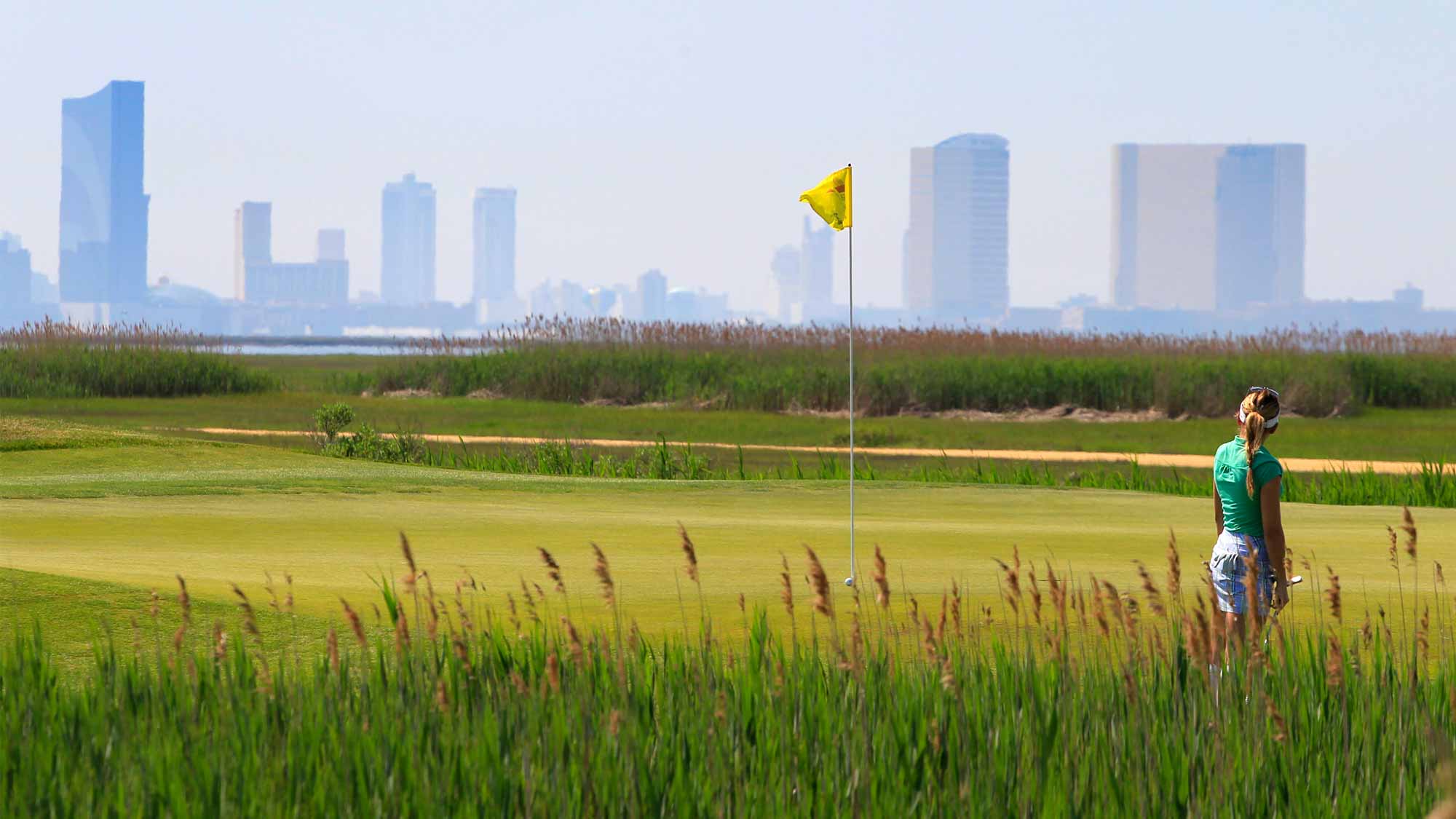
Course Conditions, Weather, Wind
New Jersey witnessed a miserable Memorial Day weekend. It rained approximately 1-2″ inches across all different parts of the state. Much like the rest of the country, there was a drought. That’s no longer the case and although we have no rain in the forecast for Friday through Sunday, the golf course is going to play on the softer side. Temperatures are supposed to reach the low 70s, but the Bay Course is on the water and the real feel will be cooler. Thankfully, the wind prediction is around 10 mph for the three days. It will blow harder at Seaview than the web says, but that’s a decent starting point.
Even with 93 bunkers and 6,000 sq/ft greens (on average), the field will score. That’s the DNA of the Bay Course. The ShopRite has seen Hall of Famers and first-timers win because the layout is so short. If you take the top BoB% players on tour and tell them they need to average five birdies a day under normal conditions, 15ladies (minimum) can do that. I’m praying the forecast holds up. The weather can be a wildcard at the ShopRite. The skill set needed to win is specific for Seaview. If the forecast holds, we will contend and have a great chance to win. Our weekly coverage of the LPGA will be a great asset in assessing this field. With the US Open across the country in eight days, we don’t have a deep roster of usual suspects. The field in Mexico was deeper. Hopefully, the LPGA gets a handle on this schedule and starts to figure this out. The Mizuho had a great field, but that was three weeks ago. In the last six weeks, the LPGA has collected two strong events. It’s April and May! Fans complain about the two overseas tours to Asia, but we are in peak season, and nobody is playing.
Tight fairways, plenty of bunkers, and hopefully some wind will give these ladies a decent test. It’s a shoot-out at the Jersey Shore. Let’s find some women who can make 5+ birdies per round for three straight days.
How to win?
Breaking down the ShopRite is all about accuracy. The course is very short for modern LPGA standards. The tour continues to go here because the crowds give the ladies tremendous support, but under normal conditions, it is not a professional test. The lead skill we seek is approach play. Our two RTL winners, Henderson and Buhai, were in the top 5 on tour for iron play when they won. The average approach length is short at Seaview’s Bay Course. Five of the 11 par 4s are under 350 yards in length. Add in a very short par 3 on 17, and that’s six approaches (33%) where you must create close birdie chances. Remember, the winning score is 14 or 15 under par over three rounds. Our contenders are looking to fire five under par per day to keep pace. Those six short-range approaches are important. Since the LPGA lacks specific proximity data, how can we measure who separates on short par 4s? I like par 5 scoring at the ShopRite for this reason and a couple of others.
Players who can score on the 5s have a unique combination of skills. First, they score from close range. The modern professional golfer pushes the ball down to the green in two on a par 5. That third scoring shot comes from inside 100 yards. The best birdie makers on par 5s excel on this last approach. Six par 4s and all three par 5s will reward this skill set at the ShopRite. That’s half the holes these ladies will play each day. If you can birdie four or five of those nine, you are on pace to win. Those sub-par scores are the easiest to make on tour. The second skill on par 5s that applies on the Bay Course is your long iron or fairway wood approach in two. All three par 5s are reachable at Seaview, as the average length is 490 yards for the 5s.
Those three long-iron swings on the 5s also correlate to success on the par 3s. If the Bay Course challenges anything, it is par 3 scoring. Outside of the short seventeenth, the other par 3s are over 180 yards. Each one has a small, undulating green. As we have seen the past three weeks on tour, Ross was notorious for testing players on par 3s. Add up those three tee shots and the three long second swings on the par 5s, and that’s six more situations where players can separate. The final key par 5 player trait is making birdie or better. The scoring average of the last three top 10s at the ShopRite after three rounds is 4.5 on the 5s. The leaders are going low on these holes. It doesn’t matter what the weather is; this collection of par 5s is very scoreable. You must average two birdies per day on those three holes.
Looking through the recent top 10s from the 2022 to 2025 leaderboards, putting ranks second in strokes gained importance. That makes sense, because this is a three-day shoot-out. Wind–swept courses like this one are required to have relatively benign putting greens because the slopes will not hold balls in the wind. They do have shelves and sections, but when you get on the right plateau, the putting becomes very straightforward. The average green is small, 6,000 sq/ft. Hit the green, and you have a legitimate birdie chance. The defending champion, Jennifer Kupcho, gained nearly three strokes per round last year with her flatstick. Women will make putts, and since scoring is all that counts, you have to pay attention to those who are trending on the greens. Consider this as well, we just left TWO Ross–designed venues. Did Donald create all of those putting surfaces? No. But the Ross DNA is there, and it exists at the Bay Course too.
How much should we pay attention to short game and OTT play? Seaview might be the only course across the LPGA and PGA TOUR where the driver really does not matter. Can it help with the 5s? Yes. There are so many short holes at Seaview, you just need to hit your wedges (very) close. That’s the consideration for the short game as well. Sure, the ladies will miss some greens, but these surfaces are really windswept flat. A decent around the green player will do fine here. You don’t really need to worry about bunker play, etc., because the field is hitting approach shots from such close range. We’re not going to overthink this; we have predicted the winner here twice. Approach, approach, approach, pick the player who will hit 75% of her GIRs, make 18 sub-par scores in three rounds, and that’s the winner.
Will any part of this event help us handicap next week? Probably not. The USGA will have Riviera set up 500+ yards longer. The driver will play a huge role in the Pacific Palisades and mid- to long- iron play. Keep an eye on the putter at Seaview. We will want to know who is popping with the flatstick, but overall, this three-round event is as much of a one–off format as is the skill set needed. Enjoy the entertainment and the NJ crowds. Nine of the last 11 ShopRites were won by one stroke or in a playoff. After a miserable Memorial Day weekend, things are about to heat up down at the Jersey Shore.
LPGA – Free Picks
Celine Boutier (+1900 DraftKings)
The 2021 ShopRite winner, Celine Boutier has been on a tear with her iron game on the last two Donald Ross venues. Ninth place at the Mizuho and sixteenth at the Kroger, the former champ is locked in on approach. The difference with Boutierversus some of the other middle-tier prospects is her putter. When Celine is scoring and stacking up top 20 results, it is always a well-rounded resume. Third in the field for rounds recorded in the 60s, and fourth in round one scoring, watch for the French lady to get off to a fast start and take this title home with a wire-to-wire finish.
Jodi Ewart-Shadoff (+7200 DraftKings)
Following the LPGA intensely for four straight years, I can say with confidence, Jodi Ewart-Shadoff at 72-1 is a total misprice. The second-best approach player in the field has proven she can play Seaview. In her last five starts on the Bay Course, Ewart-Shadoff has three results in the top 12. One of those finishes was a third place in 2022. Jodi finished sixth in Mexico earlier in May, another accuracy-driven design. When the number one skill needed is iron play, put JES on the card. Sixth in par 5 scoring, there are other skills Shadoff has that will promote contending again at the shore.


