News
Marvelous Mountain Ridge Set to Take LPGA Stage



By Nate Oxman
While the golf world is fawning over the majesty of Donald Ross’s self-proclaimed “masterpiece” at Aronimink Golf Club in the suburbs of Philadelphia as it readies to host the PGA Championship next week, another Donald Ross standout about two hours north in West Caldwell, N.J. will take the stage as the opening act.
Mountain Ridge Country Club, host of this week’s Mizuho Americas Open on the LPGA Tour, opened not long after Aronimink unveiled its Donald Ross design in 1928. While Aronimink is lauded as one of the top golf courses in golf-rich Philadelphia, Mountain Ridge is often overshadowed among the throngs of highly ranked courses in the New York metropolitan area.
With the likes of Shinnecock Hills, set to host the U.S. Open in June, Bethpage Black, most recently the site of last year’s Ryder Cup, and dozens of other courses dominating the top 100 rankings of all major golf publications and news outlets, it’s understandable Mountain Ridge may not have national notoriety.
That doesn’t make it right.
Mountain Ridge Country Club dates back to 1912, when a pair of Newark, N.J. businessmen were unable to obtain access to established private clubs in the area due to their Jewish religion. The club recruited heads of other prominent Newark Jewish families, purchased land adjacent to Essex County Country Club in West Orange, N.J., and hired that club’s pro, Robert Hunter, to craft a 9-hole course.
A.W. Tillinghast expanded that to a full 18, and Herbert Strong did a little tweaking in the 1920s too, before the club realized the property, severely sloped in certain spots, might not be the best location for the long-term success of the club.
Mountain Ridge’s leaders were intelligent enough to seek input from other prominent golf course architects at the time: Walter Travis, Seth Raynor, and Charles Banks. All three concluded that the club needed a new home, which it quickly found a little farther north in West Caldwell — and thus, a new designer.
Enter the great Donald Ross.
While Ross, a direct disciple of Old Tom Morris, was born in Scotland, he made a massive impact on American golf, crafting highly acclaimed courses like Pinehurst No. 2, Essex County Club, East Lake, Oakland Hills, Oak Hill, and Inverness.
His success at all of those sites made it possible for Ross to continue to do what he did best when he arrived at Mountain Ridge: carefully and creatively route a golf course to present a continuous variety of challenges, both as players venture from tee to green and then as they navigate the short grass with putter in hand.
And that’s exactly what Ross did at Mountain Ridge, which hosted its first big national tournament in the U.S. Senior Amateur in 2012.
It was around that time that the well-traveled Ron Prichard, a golf course architect later dubbed the “father of restoration,” finished his work at the club. His work included expanding the greens back to Ross’s specifications, widening fairways, building new back tees, adjusting the appearance and placement of bunkers that had gradually changed over time, and removing unnecessary trees.
The result was applauded throughout the golf course architecture world and helped Mountain Ridge attract the LPGA, which staged the Cognizant Founders Cup there in 2021. The club is now in its first year of a two-year period serving as host of the Mizuho Americas Open, a unique event hosted by Michelle Wie West that features both LPGA Tour and AJGA players competing side by side in separate competitions.
Tickets can be purchased by visiting mizuhoamericasopen.com/tickets. Golf Channel will have coverage of all four rounds.
The defending champion is Jenno Thitikul, who played her final 27 holes last year at Liberty National Golf Club bogey free. While players and spectators at Liberty National enjoyed jaw-dropping views of the Statue of Liberty and the New York City skyline, Mountain Ridge offers everyone on site a glimpse at a great golf course in a gorgeous parkland setting.
“Obviously, the routing is pretty outstanding. I mean, that’s easy to give you that kind of an answer, but that’s true in every case for a Ross course. I don’t think I’ve ever found a Ross course I worked on where I felt like I would reroute it. I just felt like what he had done was a perfectly balanced golf course.”
— Ron Prichard
Prichard, who began pushing for restoration of classic American golf courses way back in the 1980s, did wonderful work at Mountain Ridge — perhaps most notably on a set of greens considered superb by both he and Dr. Bradley Klein, a golf course architecture design consultant and Donald Ross expert.
“It’s a fantastic set of greens. It’s very bold, very dramatic. Muscular. It’s in the top ten of all green sets he ever built.”
— Dr. Bradley Klein
“I think that the greens at Mountain Ridge may be easily in the top five Ross courses that I’ve ever seen.”
— Ron Prichard
That’s incredibly high — yet justifiable — praise considering Ross penned nearly 400 golf courses.
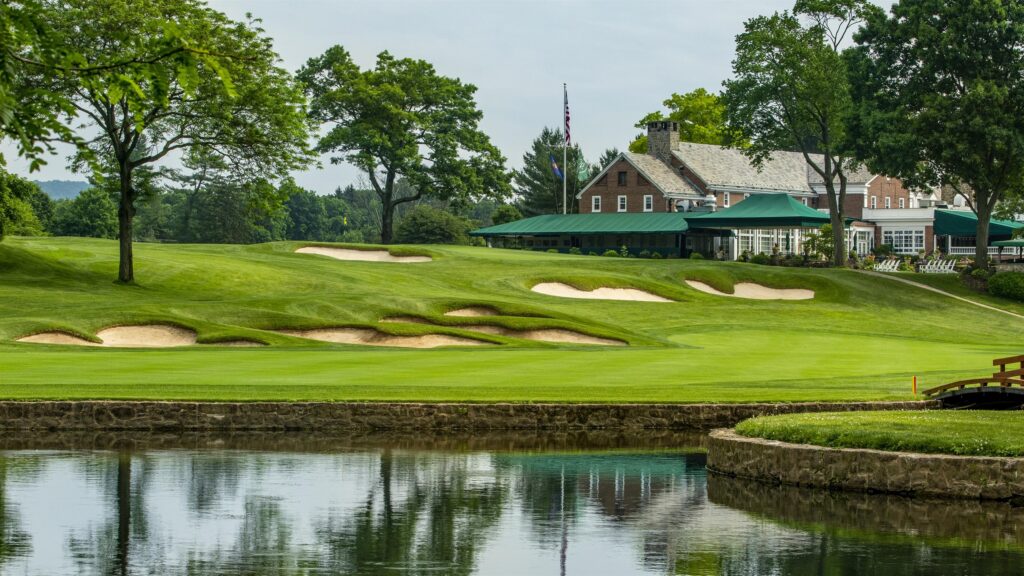
While all 18 green complexes wholeheartedly deserve recognition, the first of the elite is found right at the conclusion of the opening hole, a mid-length par 4 that plays downhill from a tee just below Mountain Ridge’s magnificent clubhouse.
Spectators at this week’s tournament should certainly spend some time by this green, studying how it accepts — and also deflects — different types of approach shots.
Another sensational putting surface sits atop a little rise at the end of the first one-shotter at the fourth hole, which can stretch as far back as 209 yards. Both vertical and horizontal spines and some dramatic tilts create a plethora of pin-placement options. Make it a point to spend some time studying this one.
Two more terrific greens are found at the sixth, a beautiful par 5 that could certainly put some players who attempt to reach the green in two in more than a few precarious positions, and the uphill par-3 seventh, which will undoubtedly wreak havoc on those who miss the green with their tee shot.
Don’t worry. There are plenty more greens to drool over on the back nine.
Let’s return to the aforementioned seventh hole, which sits in the southeast corner of the property and features another fun Ross design element: a coffin bunker that both shields the player’s view of the green’s false front and snatches low-trajectory shots.
Another such bunker precedes the fairway at the short and fun 359-yard par-4 12th, an ever-so-gentle dogleg right guarded by a narrow creek on its right side.
Klein commented on these hazards that Ross used at different times throughout his impressive career.
“So that’s a different approach to bunkering than what prevailed in the entire post-World War II era. And a lot of these short carry bunkers or intruding lines of play became considered obsolete and they were removed. And I think that that’s a shame. But a lot of those now are being restored. So what you see at Mountain Ridge, for example, is fairway bunkering that comes across partially the line of play and you have to deal with it rather than just play down the middle blindly.”
— Dr. Bradley Klein
One of Prichard’s areas of focus for his work at Mountain Ridge included rebuilding and reshaping the course’s fairway bunkers to sit more perpendicular to the line of play, as Ross intended them to be.
“Very few people understand that the axis of Ross’s bunkering was normally perpendicular. Sometimes they were placed at a slight angle, occasionally you have a linear bunker that ran parallel with the line of play. But normally that was just the kind of a bunker that was almost always placed in a position to catch balls and try to keep them from going off the golf course.”
— Ron Prichard
Prichard noted that Ross intended these bunkers, many of which feature a steep wall of grass on the far side, to prevent players from being able to play to the green.
Notable examples at Mountain Ridge can be found at the first, third, ninth, 15th, and 18th holes.
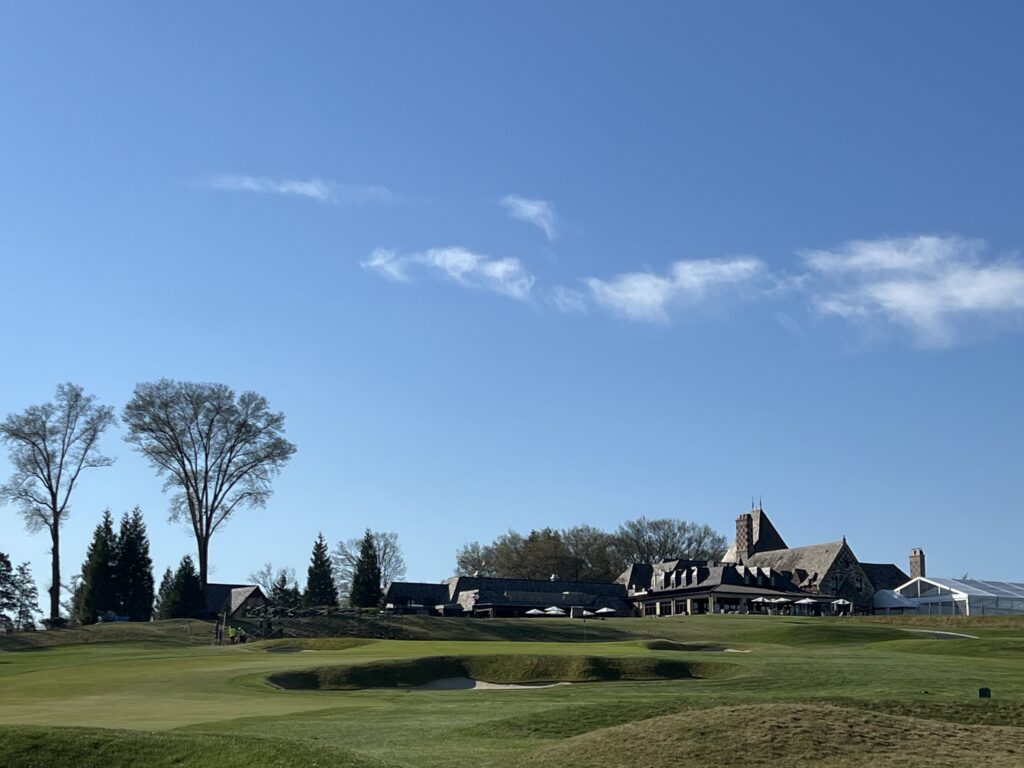
The finishing hole, a beautiful uphill, dogleg-left par 4, is also often played with small planes taking off from the adjacent Essex County Airport. It’s a quaint feature that adds to Mountain Ridge’s endless charm.
“It’s a beautiful piece of land. It’s very ideal, rolling, in terms of the terrain. There isn’t a lot of steepness, but there’s always enough contour under foot. And then the greens really have been much expanded over the years, and are just fantastic.”
— Dr. Bradley Klein