I’ll admit, I was starting to question whether or not Tom Kim was worthy of the hype he’s received.
Afterall, sports fans and sports media tend to get enraptured with people like Tom Kim – he’s immensely talented, has a wonderful and outgoing personality, and he’s incredibly young – just 24 years old.
He turned pro at 15, racked up 3 professional wins before most of the kids his age had a college diploma, and then he went the last three straight years without a win.
It was fair to wonder if the lavish praise and hearty approbation was unearned.
Then, this weekend, he put all those talents on display, and reminded everyone that his ceiling is just as high as any other young player on TOUR.
Tom Kim 4-iron to 5 FEET to go up two.
Golf shot. pic.twitter.com/5xpoYZ9KRO
— Fore Play (@ForePlayPod) July 12, 2026
The final round started with a bit of a logjam – Matt Fitzpatrick and Michael Thorbjornsen briefly held a share of the lead, but five birdies in the first 12 holes gave Kim some cushion.
Min Woo Lee briefly got the lead to within one stroke, until TK hit that 4i in the video above and made birdie on the 16th. Lee ultimately finished in solo 2nd place.
Kim made only a single bogey in his final 51 holes of the tournament, that’s almost three straight rounds without a bogey, for the mathematicians out there.
He now has 4 wins before the age of 25, the only non-Americans on that list are Rory McIlroy, Sergio Garcia, and Hideki Matsuyama. Good company.
This Guy Won More Than Tom Kim
What kind of psychopath bets $48,000 on at 84/1 bet? People are insane.
A bettor at DraftKings put $47,700 on Tom Kim to win the Scottish Open at 84/1…
They won $4,006,800
Tom Kim’s prize for winning the Scottish Open was $2.4M LESS than that payout ($1.575M) 🤯
(via @DKInsights_) pic.twitter.com/AbYD5RanFD
— Covers (@Covers) July 12, 2026
What’s Next?
The 154th Open Championship.
154th Open Championship Odds:
-
Scottie Scheffler (+620)
-
Rory McIlroy (+770)
-
Jon Rahm (+1700)
-
Matt Fitzpatrick (+1950)
-
Tommy Fleetwood (+2050)
-
Xander Schauffele (+2400)
-
Chris Gotterup (+2800)
-
Cameron Young (+2900)
-
Ludvig Åberg (+3100)
-
Collin Morikawa (+3100)
We’ve got a fog delay in Scotland on Saturday morning.
The first few players off got a few holes in, and then they called it. Here’s how the PGA Tour describes the weather on their site:
A cold front moving down from northwest Scotland overnight brought rain and fog as play began Saturday morning at The Renaissance Club. Rain was expected to become heavy briefly at 11 a.m. and taper around 1 p.m. The fog was expected to remain, but weaken throughout the day. When play was suspended, only 17 players were on the golf course.
The conditions are known as haar, a cold, wet sea fog or mist that frequently rolls in from the North Sea onto the eastern coast of Scotland and northern England.
Now we all know the word “haar”.
When the fog lifts, those who made the cut will be chasing a three-way tie at the top of the leaderboard, held by Rory McIlroy, Tom Kim, and Jordan Smith at nine-under.
In all, there are 12 players within two shots of the lead – and 37 within five.
Several big names missed the cut this week; Scottie Scheffler, Ludvig Aberg, Brooks Koepka, Patrick Cantlay, and Xander Schauffele among them.
Who’s Chasing?
-8 M Fitzpatrick, MW Lee; –7 C Gotterup, R MacIntyre; –6 N Hojgaard, W Clark; -5 P Reed; -4 J. Thomas
Full Leaderboard & Tee Times Here
How To Watch The Action This Weekend
-
Saturday-Sunday: 10 a.m.-noon (Golf Channel); noon-3 p.m. (CBS)
Good news for anyone who likes golf, random stats, and proving they know more ball than their friends.
We’re happy to announce that we have built four free Golf Trivia games on Caddyshanks. They are live now, they are free to play, and we want you to try them out.
Eventually, we think it would be pretty cool to have a monthly leaderboard with golf prizes. Maybe a winner every month. Maybe some gear. Maybe eternal bragging rights. We’ll see where it goes.
For now, we just want you all to test them, play around, and give us feedback.
For example, if today’s games are way too easy, you can tell us. If they are broken, definitely tell us. If you get hooked and waste 20 minutes trying to remember who gained more strokes putting in 2023, that is technically the point.
Here Are The Four Games
Big Board
Rank ten golfers by a specific stat.
Sounds simple. Then you realize you have to decide whether Brian Harman or Tommy Fleetwood had the better number in a category you only pretend to understand.
Scouting Report
Guess the golfer based on the clues.
You get three tries. Use them wisely.
Going Streaking
Pick who had more and keep the streak going.
It is very easy to feel smart after two correct answers. It is even easier to get humbled on the third.
Mileage Marker
Guess the distance between two golf courses.
This is for anyone who has ever looked at a map and said, “Yeah, that’s probably only like two hours away,” before ruining an entire golf trip itinerary.
Go Play
The games are free, they are live, and we’d love your feedback as we keep building them out.
You’ve probably never heard of Marcus Plunkett, but his journey to The Open is worth noting. Plunkett graduated from West Point in 2016 where he played golf. After Graduating he would go on to serve his country stationed in far away lands and ultimately doing a six month tour of Afghanistan.
As his military career started to wind down in 2021, he did what all men with more time on their hands do, become an alcoholic. Just Kidding. He got back into golf and decided he wanted to make a go of it and become a pro.
After excelling on the Dakotas Tour, he gained status on the Korn Ferry Tour. However he failed to make 12 of 20 cuts and all of his 7 world ranked starts have come in Asia where he has tied for 6th twice.
At the 36 hole final Qualifier at Dundonald Links course in Scotland, Plunkett put a 69, and a 72 on the score card putting him at 3 under par and tied for fourth. It also got him a spot in his first major. We’ll be rooting for him to qualify and stamp his name firmly in the history of Golf.
Every golf trip eventually has the same moment.
Someone is standing next to the cart after 18 holes, trying to figure out who won what match, how many points that means, who still has a chance tomorrow, and whether Dave was actually getting a stroke on 13 or just made that up somewhere around the turn.
That person is usually the same guy every year.
He brings the spreadsheet. He makes the teams. He tracks the matches. He answers 14 different versions of “wait, what do we need here?” He becomes the unpaid commissioner of a golf trip that was supposed to be relaxing.
That’s where CupTracker comes in.
CupTracker does one thing, and it does it very well: it runs your Ryder Cup-style golf trip from start to finish.
Not your swing. Not your stats. Not your tee time booking. Not your range session. Just the actual team competition that turns a regular buddy trip into something everyone talks about for the next 11 months.
If your group does teams, foursomes, fourballs, singles, handicaps, side matches, and a live leaderboard, CupTracker is built for you.
Built For The Buddy Trip Commissioner
Most golf apps try to do everything. CupTracker is different. It is built for one specific type of golf event: the annual buddy trip where the boys pretend they’re at Bethpage, Whistling Straits, or Marco Simone, except the opening tee shots include breakfast beers and at least one guy wearing joggers he absolutely cannot pull off.
The best part is that it removes the worst part.
No more scoring math on the back of a scorecard. No more group texts trying to figure out the standings. No more one guy disappearing into a spreadsheet for an hour after dinner while everyone else is asking if singles pairings are out yet.
CupTracker handles the live scoring, automatic handicapping, custom formats, and live leaderboard. Everyone can follow the event from their phone, which means the trip immediately feels more official.
And let’s be honest, that’s half the fun.
Make The Trip Feel Like A Real Event
A Ryder Cup-style buddy trip is not just about playing golf. It’s about the scoreboard. It’s about knowing your match matters. It’s about standing on the 17th tee with your team watching and realizing you have to hit the fairway even though you have not done that once all day.
It’s about turning a normal round into something with a little juice.
CupTracker makes that easier to run.
The app was originally built three years ago for the founder’s own annual trip. Since then, it has scored more than 1.6 million holes across real tournaments.
That’s a lot of conceded three-footers. And probably a few that should not have been conceded.
What used to take an hour of spreadsheet work now updates in real time. Matches move. Points change. The leaderboard shifts. The group can see exactly where things stand without waiting for someone to do math while holding a half-eaten sandwich.
The Upgrade Your Annual Trip Needs
For trip organizers, that’s the real win.
Because running one of these events is fun in theory, but it can become a full-time job pretty quickly. You have to build the teams, apply handicaps, set the formats, track the matches, keep score, update standings, and explain to the same four guys every year what fourball means.
CupTracker takes a lot of that off your plate.
So if your group runs the same trip every year, or you’ve been talking about finally doing a Ryder Cup-style event, this is the upgrade that makes it feel like a real tournament.
Not “Jim made a spreadsheet and we think Team Red won.”
A real tournament.
Live scoring. Real-time standings. Custom formats. Automatic handicapping. All in one place.
Basically, it lets your group enjoy the fun part of a Ryder Cup-style competition without turning one guy into an unpaid assistant captain, rules official, accountant, and IT department.
Use code CADDYSHANKS for 10% off, good through the end of September.
The Travelers is underrated.
It finds a way to deliver every single year and the fans always show out – even after a rain delay.
In 2024, Scottie Scheffler defeated Tom Kim in a playoff.
In 2025, Keegan Bradley won in electrifying fashion on the final hole over Tommy Fleetwood.
This morning, we were treated to yet another playoff. This time, with Scottie Scheffler going toe to toe with Viktor Hovland. Here’s how we got there yesterday evening:
⚡️🇺🇸⛳️ #ELECTRIC — The crowd went WILD when Scottie Scheffler hit the putt on 18 to send the Travelers into a playoff
“USA! USA! USA!” @SchefflerFans pic.twitter.com/KimKr7vyQL
— NUCLR GOLF (@NUCLRGOLF) June 29, 2026
The Playoff
Scheffler and Hovland were set to play the 18th hole, until one of them won.
It ended on their first attempt.
Hovland made a huge birdie putt, Scheffler would go on to miss his own from about five feet.
Viktorious again!!! This putt put Viktor Hovland back in the winners circle at @TravelersChamp. pic.twitter.com/ElfafbNOPw
— Skratch (@Skratch) June 29, 2026
That’s the 8th TOUR win for Viktor Hovland in his career, and 12th win overall.
Funny enough, he missed the cut the week before both of his last two wins.
Missed the cut last week at the U.S. Open.
Missed the cut at The Players before winning the 2025 Valspar.
What’s Next?
The John Deere Classic
Odds: John Deere Classic
-
Ben Griffin +1300
-
Chris Gotterup +1375
-
Keith Mitchell +1750
-
Keegan Bradley +2600
-
J.T. Poston +2700
-
Eric Cole +2700
-
Jordan Spieth +2800
-
Jackson Koivun +2800
-
Pierceson Coody +2800
-
Jacob Bridgeman +3000
Earlier today Scottie Scheffler and Viktor Hovland squared off in a sudden death playoff to see who is the Travelers Champion. With Hovland and Scheffler both looking at makable birdie putts there was air that this could go some distance. Unfortunately, Hovland drained his and Scottie two putted, how dare he? I love a playoff and was hoping it would go on forever. It didn’t so I decided to search the greatest playoffs in the history of golf. Here they are:
1. 1913 U.S. Open (The Country Club, Brookline) Francis Ouimet def. Harry Vardon and Ted Ray
If you love golf movies or golf history you know this story. Widely considered the greatest match ever played. The 20 year old amateur Francis Ouimet took down Two British legends who had both won the U.S. Open in the past. After 72 holes the three were even ,and at the time the Playoff was a full 18 the next day. Through rainy conditions, the heavy underdog and his 10 year-old caddy finished one under with a firm 5 stroke lead. The match was an amazing story that catapulted golfs popularity in America. Amateurs everywhere owe Ouimet a debt of Gratitude.
2. 2000 PGA Championship (Valhalla) Tiger Woods def. Bob May
3. 2008 U.S. Open (Torrey Pines) Tiger Woods def. Rocco Mediate
Woods played on a torn ACL and stress fractures, forcing an 18-hole playoff with a dramatic birdie on the 72nd hole, then winning on the first sudden-death hole. It epitomizes resilience and is often called one of the most compelling major finishes ever, blending physical drama with elite competition.
4. 1987 Masters Larry Mize def. Greg Norman (and Seve Ballesteros)
5. 1950 U.S. Open (Merion) Ben Hogan def. Lloyd Mangrum and George Fazio
Final Thoughts:
Now there’s a lot we missed that maybe could of made it. But we chose these five based on the history, who was involved and what the event was. Obviously majors take precedent. We would love to hear what your favorite playoffs are, sound off in the insta comments
Tiger Woods made his first public appearance Tuesday since his March car crash and arrest. He introduced Brian Rolapp ahead of the TOUR’s big announcement today.
And the PGA TOUR is finally doing the thing it has been hinting at for months: blowing up the schedule and starting over.
Beginning in 2028, the TOUR will move to a two-series model. At the top will be the PGA TOUR Championship Series, where the best players will play the biggest events. Under that will be the PGA TOUR Challenger Series, which will basically become the path for players trying to earn their way back into the big boy room.
The Championship Series will run roughly February through August and include 23-24 events, with the majors, The Players, team events, and a reworked postseason all folded in. These events will have 120-player fields, 36-hole cuts, and minimum $20 million purses.
So yes, cuts are back. Praise be.
The Challenger Series will have at least 20 events, 144-player fields, 36-hole cuts, and minimum $4 million purses. The top 20 players from that series will earn promotion each season, while the top 90 in the Championship Series will keep their spots. Win twice on the Challenger Series, and you can earn your way up immediately.
There will also be a “last chance” fall series for players trying to hang onto, or regain, Championship Series status. Think of it as golf’s version of a playoff for your job.
The TOUR Championship is changing too. East Lake will still host this year and again in 2027, but after that, the event is expected to rotate to “prestigious courses.”
And not just regular prestigious. We’re talking Pine Valley, Cypress Point, and Seminole.
For decades, golf fans have heard about these mythical places, but unless you knew a guy who knew a guy whose grandfather invented municipal bonds, you probably weren’t getting anywhere near them. Now, we may actually get to watch the best players in the world compete there with a trophy on the line.
Also, Match Play is expected to become part of the TOUR Championship picture, which is another welcome change. It will add some drama to what has become a lifeless end of season experience for fans.
Sign us all the way up. These changes are overall pretty small, and all of them are pretty fan forward, at least on the surface.
Rory McIlroy also released a statement supporting the new structure, saying:
“Today’s announcement is a positive step for professional golf. As more details emerge, it is encouraging to see the PGA Tour reaffirming the importance of meritocracy and creating a structure that will serve both players and fans well into the future
“I’ve always been proud to compete around the world, and the collaboration between the PGA Tour and DP World Tour is one founded in the betterment of the game globally. The commitment to elevate some of these historic international tournaments and national opens is incredibly important for the game and something I’m very supportive of.
“Over the last few years, golf has faced a period of uncertainty and division, which has not been in the best interests of the players, or the fans of the game. Today, we are putting the fans first, and I am excited about the future of our sport.”
Now, this is the same Rory who made headlines at the U.S. Open for calling the new Track 2 system “glorified Korn Ferry events,” so there is at least a little bit of message-board whiplash here.
But his larger point is probably the right one. Golf has been stuck in a weird, exhausting, political mud fight for the last few years, and fans have been the ones left trying to make sense of it.
In plain English: the PGA TOUR wants fewer meaningless weeks, more best-on-best golf, clearer stakes, and a real promotion/relegation system.
In even plainer English: the rich get richer, the middle class gets nervous, and golf fans may finally get a schedule that is easier to follow.
There are still plenty of details to figure out, but the direction is clear. The PGA TOUR is trying to become more like a real sports league.
Whether that fixes everything?
We’ll see.
But at least “Signature Event with no cut and half the field missing” appears to be headed for the big leaderboard in the sky.
That was a gutsy win for Wyndham Clark.
To overcome the course, make championship-level putts while watching your lead slip away, do it while paired with the World No. 1, fight a two-way miss off the driver, and have the entire crowd against you – that is nothing short of impressive.
People will try to hand-wave away his victory. There are already people saying things like, “He won this tournament in a 45-minute window on Thursday,” as if that matters at all.
He won the U.S. Open because he maintained his composure and flat-out putted better than everyone else in the field.
Look at that stat below. Do you know how insane that is?
When someone putts like that, it’s hard to beat them. Doesn’t matter if it’s in your club match, your buddies match, or the U.S. Open.
Putts from 20 to 25 feet.
• PGA Tour average: 12 percent
• Wyndham this week: 50 percentpic.twitter.com/DV0dgx9FtC— Jamie Kennedy (@jamierkennedy) June 21, 2026
The Fans In NY Stink
Wyndham Clark deserved better treatment from the fans in New York, and they were an odd group of “fans” all week.
Saturday, people were streaming out of the place early, and then on Sunday they all showed back up to cheer against their countrymen?
Now, I understand that people have a low tolerance for multi-millionaire golfers being whiny, and destroying locker rooms. Wyndham Clark has had some bad moments. It’s weak behavior, and should be called out.
But the man apologized, he paid restitution, and the members at Oakmont have repeatedly said that they are good with Wyndham, and that they have moved on.
So, why can’t everyone else move on? It’s fine to dislike a player for poor behavior, it’s also fine to cheer for Scottie Scheffler, but this trend of actively cheering against players, like what happened to Matt Fitzpatrick earlier this season, is lame.
Wyndham handled every bit of the heckling with class, and held on despite it.
By the way, he now has as many majors as Bryson DeChambeau, Dustin Johnson, Bernard Langer, Greg Norman, and Johnny Miller. Source
What else?
Sam Burns played incredibly well on Sunday, he had a birdie putt on the 72nd hole to tie Clark, which missed by about 1/16th of an inch. This is the 2nd year in a row he’s had a heartbreaking 2nd place finish at the U.S. Open.
Sam Burns was asked about the first thing his dad said to him when he got off the course.
His answer was wonderful. pic.twitter.com/dVjtUk2Ymu
— Kyle Porter (@KylePorterNS) June 21, 2026
What’s Next?
The Travelers Championship.
Odds: Travelers Championship
-
Scheffler +400
-
Fleetwood +1600
-
Schauffele +1600
-
Young +2000
-
Aberg +2000
-
M.Fitzpatrick +2000
-
Burns +2000
-
Clark +2200
-
Morikawa +2500
-
Cantlay +2500
-
Thomas +2800
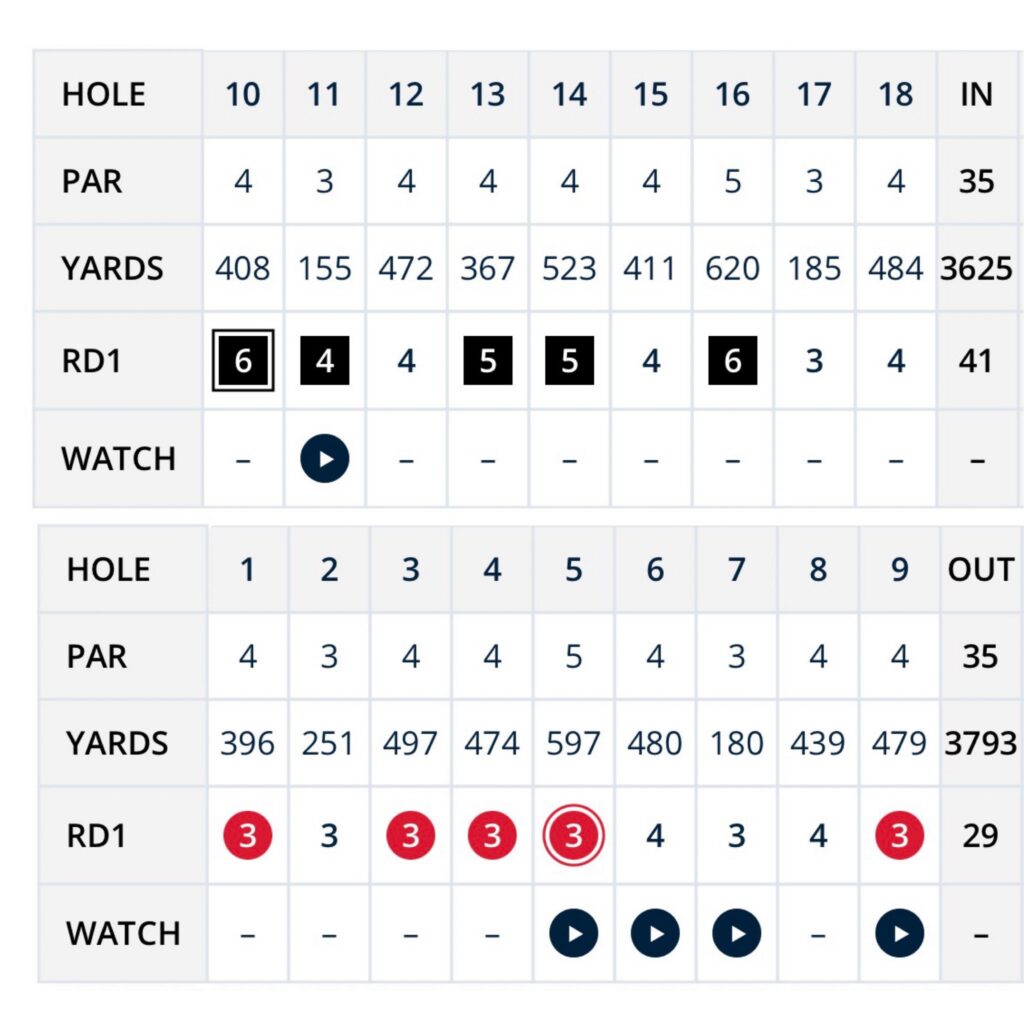
Keith Mitchell finds himself at even par after the first 18 on Thursday. Not crazy, unless you watched how he got there.
Holes 10-18
Starting on the 10th hole at Shinnecock, he proceeded to double bogey (we accept you, one of us). Unfortunately for him, the next 8 holes would include 4 more bogeys & zero birdies. He even bogey’d the par 5 on hole 16. Which if you’ve never heard Tigers tips for lowering your score he is vehemently against bogeys on par 5s.
Mitchell would end up shooting a 41 (dream 9 for me) on his first 9. Not gonna lie they had him in the first half.
Holes 1-9
Then somehow the sun shined through the dark clouds and found Mitchell’s game. Mitchell would go on to shoot a 29 on through his last 9, Totaling 4 birdies, 1 eagle, & zero bogeys. Absolutely incredible golf by him when he needed it most.
Final Thoughts
I have obviously never played 9 as good as his awful front 9 today. But I have to imagine Mitchell returns tomorrow with the confidence to keep it going. Golf is tricky though and anything can happen. I’m hoping he’s dialed tomorrow for all 18.
Last thing: Guy had a great fit today. Looked like pure class, gotta think that had something to do with his back 9 come up.