News
Titanic Thompson: The Greatest Golf Hustler Who Ever Lived



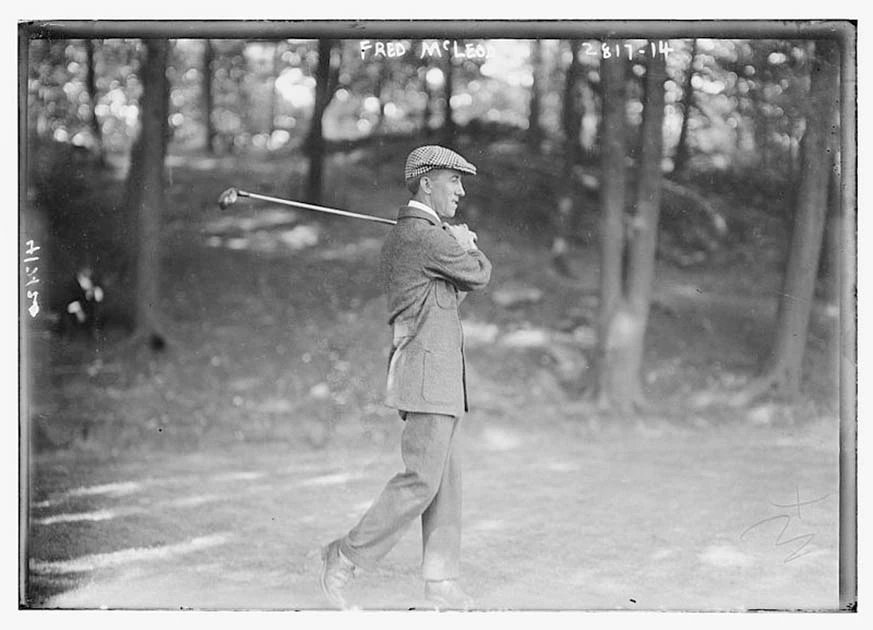
You don’t need to know a thing about golf to enjoy this guy. You just need to know one rule: if a tall, polite stranger with very sharp eyes offers you a friendly little wager, keep your wallet in your pocket.
His name was Alvin Clarence Thomas. The world knew him as Titanic Thompson, and for about half a century he made a living betting on cards, dice, pool, shooting, golf and pretty much anything else that could be turned into a bet. Sam Snead, one of the greatest golfers ever, called him “the greatest hustler ever.” Minnesota Fats, the famous pool player, called him “the greatest action man of all time.”
Thomas was born in Monett, Missouri, on November 30, 1892 or 1893. Even the paperwork can’t agree: his military records say 1892 and Social Security says 1893. He grew up on a hog farm outside Rogers, Arkansas, where he got very good at shooting, checkers, dominoes and pitching pennies. He left home at 16, supposedly with less than a dollar, and soon joined a traveling medicine show doing shooting demonstrations. Before long he quit the show to gamble full time.
In the spring of 1912, in Joplin, Missouri, he won $500 off a local gambler. The famous Golf Digest version adds a double-or-nothing bet that he could jump across a pool table without touching it, which he did, headfirst. When somebody asked the stranger’s name, the beaten gambler is said to have answered, according to the Encyclopedia of Arkansas, “Beats me. But it ought to be Titanic, the way he’s been sinking everybody around here.” The real Titanic had gone down just days earlier. Thomas liked it and kept it. Later a newspaper reporter misspelled his last name as Thompson, and he decided that sounded better too.
His specialty was the “smooth proposition,” a bet that looked impossible to the other guy and was already rigged. These are the stories he and his friends told, so file them under legend:
Thompson took up golf around age 30, in San Francisco, and picked it up absurdly fast. His signature move: beat you by a hair playing right-handed, then offer double or nothing playing left-handed. People jumped at it. He was a natural lefty.
Ben Hogan, a golf legend himself, put it simply: “He can play right- or left-handed; you can’t beat him.” Asked why he never turned pro, Thompson reportedly said, “I could not afford the cut in pay.”
Legend has a few big paydays too. By Thompson’s own telling, he talked golf down to a San Francisco club pro, lost their first nine-hole match, then won a rematch with about $60,000 riding on it counting side bets, and walked away with $56,000. He also claimed he shot 29 on the back nine to beat a young Byron Nelson for $3,000. Nelson, asked about it decades later, remembered things a little differently: he gave Thompson three shots, shot 69 to Thompson’s 71, and had no idea about the money.
In September 1928, Thompson sat in on a famous New York poker game with Arnold Rothstein, the gambler tied to fixing the 1919 World Series. Golf Digest reports Rothstein lost $475,000 in that game, $30,000 of it to Thompson, and paid in IOUs. Weeks later Rothstein was shot dead. At the murder trial, a prosecutor asked Thompson what he did for a living. His answer became famous: “I play a little golf for money.” The accused, George McManus, was acquitted.
The charm came with a body count. In 1910, after a dice game in Marked Tree, Arkansas, he killed a man with a hammer and claimed self-defense. Over his career he shot and killed four more men, all trying to rob him of his winnings. No charges were ever filed. He married five times, and some of the old pros he toured with later called him a cheat and a thief.
He never really stopped hustling. He died in a nursing home near Dallas on May 19, 1974, with almost no money left. He once said, “I’ve been broke, but never for more than six hours at a time.” Damon Runyon is said to have based Sky Masterson, the smooth gambler of Guys and Dolls, on him. That one is also legend, though it’s an easy one to believe.
So next time a stranger at the bar offers you an easy bet, ask him one question first: is your name Ty?